Universal Declaration of Human Rights

The Universal Declaration of Human Rights, which the United States voted to support when it was ratified by the United Nations in 1948, states that

"everyone has the right to a standard of living adequate for the health and well-being of himself and of his family, including food, clothing, housing and medical care and necessary social services, and the right to security in the event of unemployment, sickness, disability, widowhood, old age or other lack of livelihood in circumstances beyond his control."
(United Nations General Assembly Resolution 217A (III), www.un.org/Overview/rights.)

However, The United States have not signed on

why are we "NH Under The Bridge"?

NH Under The Bridge is an organization founded on the principle that in order to end homelessness, people who are homeless must become an organized, effective voice for systemic change.

Our position is that if you lose your housing and chose to live in public spaces rather than go to shelter the police should not abuse your constitutional and human rights! We fight to end selective enforcement of Quality of Life regulations (we ask "Whose Quality of Life" is improved by moving homeless people from public spaces?)

It's not a homeless crisis - it's a housing crisis!


The city's best hope for reducing and preventing homelessness is a commitment to addressing the skyrocketing rents and general housing shortage that plagues NH and drives people by the thousands into homelessness. Yet at the same time as the homeless population continues to escalate, landlords and the city continue to keep buildings empty and gentrify our neighborhoods.

We are a citywide organization and our constituency includes homeless people living in shelters as well as those living on the streets and in other public places. We serve a broad population of people because homelessness cuts across all boundaries: race, ethnicity, culture, gender, family composition, age, sexual orientation, language, etc., but what all homeless people have in common as a community is extreme poverty and social stigmatization.

There are currently over 5000 people in the NH shelter system, In addition the 14.000 people who came forward to ask for help but found no room at the shelters. These numbers do not include street-dwelling homeless people, or the hundreds of families waiting for placement in a shelter, or the doubled-up households throughout the state that go uncounted.

Our outreach targets individuals from within the shelter system, as well as those who are unable/unwilling to live within it. We meet them on their turf and their terms.

NH Under The Bridge was founded on the principle that homeless people have civil and human rights regardless of our race, creed, color or economic status. NH Under The Bridge Was founded by homeless and formerly homeless people. We refuse to accept being neglected and we demand that our voices and experience are heard at all levels of decision-making that impact us.
We oppose the quality of life laws that criminalize homeless people in any form by the city, state and national governments. We work to change these laws and policies as well as to challenge the root causes of homelessness. Our strategies include grass roots organizing, direct action, and educating homeless people about their rights, public education, changing media stereotypes, and building relationships with allies.


"Under the bridge isn't just a place, It's a way of life some have to face cold and alone outside the fortunate can’t live life, cause they can't afford it. Under the bridge isn't a place, it's a feeling you get when you are all alone, no rescue in sight and The only thing on your mind is where you'll sleep tonight"-Jamie Kupchun 1999

Gimme Shelter 2009

Gimme shelter will take place on the sidewalk in front of the Statehouse in Concord on Friday night Nov. 6th til Saturday.
Come and put up your tent, feel for one night what its like to not have a warm home to go to.
Join other activists and people experiencing homelessness, honor them by listening to their stories, and feel free to bring extra warm clothing to share.

NH has acute shortage of housing stock 2009

afsc.org
NH has an acute shortage of housing stock, especially of housing (both for home ownership and for rental) affordable to households earning less than area median income. In the past decade we have built fewer than 900 new multifamily units, and some of those have been luxury apartments.
Rents in the southern half of the state have increased as much as 37% over the last 5 years. The state median rent is $978/month, and over $1000 per month in Manchester, Nashua and Portsmouth.
Based on projections from the NH Economic and Labor Market Information Bureau, 65% of new jobs will pay less than the state level "housing wage" of $18.81, the amount needed to afford a typical apartment.
6553 people were sheltered in NH's emergency shelters in FY03, but 13,529 were turned away because there were no available beds. That doesn't count the number of people doubled up with friends or family.

Because of HUD cuts in funding, the NH Housing Finance Authority, among others, have closed their waiting lists for Section 8 Housing Vouchers and will not be able to issue any new vouchers for the foreseeable future. This means that low income families do not have access to subsidies for their rent. where do they go now?
Because land cost and construction costs are so high in most of the state, new construction of affordable housing can generally only be done using various federally funded housing production programs (Low Income Housing Tax Credits, HOPE VI, Rural Housing, project based Section 8, etc.)

lost and found

lost and found
joe and Razor dearly missed

death on the street

Our friend Joe was a diabetic Christian man who lived outside for the past 10 years. He found that he wasnt comfortable at the shelter because people used profanity. When I first met him he told me if I wanted to know who he was I would have to read the book of Job from the bible. He read the New Testament everyday and at Homeless Memorial Day vigils he sang "Amazing Grace"like an angel.

I wish that his story ended the way of Job when God returned him to renewal and prosperity. "And Job died being old and full of days" I do not know the ways of God, perhaps Joe lived to teach us compassion.

Joe was found in his camp, passed away on May 24th, 2008.
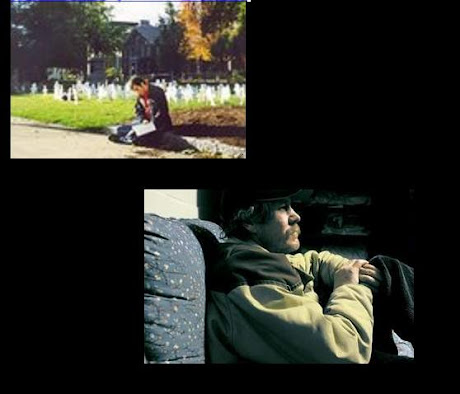
This picture was taken the year he went with us to "Gimme Shelter" a sleepout on the NH Statehouse.

The figures behind him are a visual representation of the persons who had already passed away in NH while homeless.


'Word was he died on the street'
Homeless to honor their friend 'Razor'
By SHIRA SCHOENBERG Monitor staff
here
October 21, 2008
Monitor file Raymond “Razor” Luoma, who was homeless, died last week. He was well-known to other homeless people in Concord.

The homeless community will remember one of their own, Raymond "Razor" Luoma, at an event Friday night.
Luoma, 50, died last week. "The word was he died on the street," said the Rev. David Keller, pastor of First Congregational Church in Concord, which houses a winter shelter where Luoma had stayed.
The Monitor profiled Luoma last year. He had been homeless for most of his life. Keller said Luoma was a survivor of Eastern equine encephalitis and had been interviewed by the Centers for Disease Control and Prevention. "He wore that like a badge," Keller said. "He thought he was some kind of stuff for having CDC researchers talk to him."
He is survived by two daughters, a brother and a sister. A graveside service will be held at 11 a.m. today at Maple Grove Cemetery in Concord.
The American Friends Service Committee will include a memorial to Razor in its annual program Give Me Shelter, which will be held Friday night. The program will include a group of mostly high school and college students sleeping outside to dramatize the plight of the state's homeless population, said Arnie Alpert, the state's program coordinator for the AFSC. The group will set up about 4 p.m. in front of the State House, then will go to the Friendly Kitchen for dinner and return to the State House Plaza for a discussion that will include people

Manchester NH

Manchester NH

The lost

The lost
"Father, Why have you forsaken me?"

The sight of your cities pains the eyes of the red man

The sight of your cities pains the eyes of the red man
Like a man who has been dying for many days, a man in your city is numb to the stench.

about the project

Under The Bridge is self supporting through our own contributions and it survives on God's Providence, through your generosity. We are not a non-profit and do not give tax receipts. Nothing comes in that does not go out directly to the people in need. We dont need money, we need goods and food to distribute.

We can’t measure smiles; how many weeks it takes for someone to finally trust us and tell us their name.
Some get financially better off; they become employed, sober, or qualify for other programs.
Some get off the street,Some don’t. Some die.
We are not in charge of the final outcome but we are able to help along the way with a little compassion and a lot of understanding. Anyone can do what we do.It starts with a smile and a greeting.

We have found that one of the most important things you can offer is your time and friendship. We see the same people every day and make sure we know their name and begin to find out their story. That way we can find out what they need and want instead of having to guess what they could use. Each person is an individual, one may need new socks and someone else would need a toothbrush.
Your friendship is invaluable. Your experience, strength and hope is all you can offer at times, it is essential.

As homelessness continues to increase, so does the outrage of death on our streets. Having a permanent roof over one’s head, an adequate income and health care would greatly reduce the number who die homeless.
Having treatment programs with available drop-in beds would further facilitate the addict into recovery from the street, as is is not normal for a street person to be able to call for a bed daily, as is required now.


I Stand at the Door

By Sam Shoemaker (from the Oxford Group)


I stand by the door.
I neither go to far in, nor stay to far out.
The door is the most important door in the world -
It is the door through which men walk when they find God.
There is no use my going way inside and staying there,
When so many are still outside and they, as much as I,
Crave to know where the door is.
And all that so many ever find
Is only the wall where the door ought to be.
They creep along the wall like blind men,
With outstretched, groping hands,
Feeling for a door, knowing there must be a door,
Yet they never find it.
So I stand by the door.

The most tremendous thing in the world
Is for men to find that door - the door to God.
The most important thing that any man can do
Is to take hold of one of those blind, groping hands
And put it on the latch - the latch that only clicks
And opens to the man's own touch.

Men die outside the door, as starving beggars die
On cold nights in cruel cities in the dead of winter.
Die for want of what is within their grasp.
They live on the other side of it - live because they have not found it.

Nothing else matters compared to helping them find it,
And open it, and walk in, and find Him.
So I stand by the door.

Go in great saints; go all the way in -
Go way down into the cavernous cellars,
And way up into the spacious attics.
It is a vast, roomy house, this house where God is.
Go into the deepest of hidden casements,
Of withdrawal, of silence, of sainthood.
Some must inhabit those inner rooms
And know the depths and heights of God,
And call outside to the rest of us how wonderful it is.
Sometimes I take a deeper look in.
Sometimes venture in a little farther,
But my place seems closer to the opening.
So I stand by the door.

There is another reason why I stand there.
Some people get part way in and become afraid
Lest God and the zeal of His house devour them;
For God is so very great and asks all of us.
And these people feel a cosmic claustrophobia
And want to get out. 'Let me out!' they cry.
And the people way inside only terrify them more.
Somebody must be by the door to tell them that they are spoiled.
For the old life, they have seen too much:
One taste of God and nothing but God will do any more.
Somebody must be watching for the frightened
Who seek to sneak out just where they came in,
To tell them how much better it is inside.
The people too far in do not see how near these are
To leaving - preoccupied with the wonder of it all.
Somebody must watch for those who have entered the door
But would like to run away. So for them too,
I stand by the door.

I admire the people who go way in.
But I wish they would not forget how it was
Before they got in. Then they would be able to help
The people who have not yet even found the door.
Or the people who want to run away again from God.
You can go in too deeply and stay in too long
And forget the people outside the door.
As for me, I shall take my old accustomed place,
Near enough to God to hear Him and know He is there,
But not so far from men as not to hear them,
And remember they are there too.

Where? Outside the door -
Thousands of them. Millions of them.
But - more important for me -
One of them, two of them, ten of them.
Whose hands I am intended to put on the latch.
So I shall stand by the door and wait
For those who seek it.

'I had rather be a door-keeper
So I stand by the door.


Blog Archive

Saturday, November 14, 2009

Homeless Memorial Day vigil 2009

many times people come forward with names that should be on our list, here is how it happens:


My Uncle's name was Howard E. Heselton, Jr. (Hezzy) born June 20, 1950 and he died December 24, 2001."

beating and robbery of homeless man in concord

The link:
http://www.wmur.com/news/21615804/detail.html?taf=man


CONCORD, N.H. -- Three Concord residents are facing attempted murder charges in connection with what police have called a severe beating and robbery of a homeless man.

According to investigators, Thomas Croswell, Robert Potter and Jamie Locke attacked and robbed the victim Wednesday night in wooded area near the Everett Arena. Police said the assailant tried to dispose of the victim in the river.

The 19-year-old victim remained hospitalized Saturday. The three assailants are set to be arraigned Monday on conspiracy to commit murder charges.


-----------------------------------------------------


now most likely these other people camped along the river will be forced out. There is no room at the shelter in Concrod, McKenna House houses about 30 people. There is an overnight emergency shelter in a church, but folks prefer to have a place to stay also during the day. especially like today with hard rains.

we'll keep you posted

Thursday, October 29, 2009

another daughter found a parent on our memorial list

It isn't a hard thing to list someone's name
someone you may have know or not,
someone from your community
who wasnt born homeless
who had a family
that disengaged or were lost

it isn't hard to answer questions when
family members find a name
of their loved one.

each name has a story
all theirs
but part mine,
part yours
and most of all how we treat each other


"The sole meaning of life is to serve humanity"
-Leo Tolstoy


"For every hour and every moment thousands of men leave life on this earth and their souls appear before God. And how many of them depart in solitude, unknown, sad, dejected that no one mourns for them or even knows that they have lived or not. “ -Fyodor Dostoevsky

Monday, September 14, 2009

10 reasons why people choose to be homeless


10 reasons why people choose to be homeless

Rarely does anyone ever choose to become homeless. I won’t deny the existence of a tiny minority of Robinson Crusoe types that put on their backpacks and drop out of society, favoring a simple lifestyle of woodland living. Some people do this for a relatively short period, more like an extended camping trip but there are very, very few indeed that maintain this lifestyle for a protracted amount of time. Of the remaining ninety-nine percent the reasons for becoming homeless are many and varied but whatever the initial cause of their homelessness and despite all the programs and shelters and missions that are available today some do appear to remain homeless by choice. If you actually ask homeless people why with all the services available do they prefer to stay on the streets, some will even tell you that they choose to be homeless. But do they really? The reality is a lack of suitable alternatives.

1 Safety
Many homeless people avoid using shelter services for fear that their personal safety could be compromised. Whilst most shelters take precautions where practical they are often run, through necessity, on skeleton staff levels of volunteers who are likely not professionally qualified to deal with violent conduct and as such cannot guarantee personal safety. There may well be violent offenders, addicts and mentally imbalanced individuals sharing the room in which you would be expected to sleep.

2 Personal belongings
Homeless people travel light. They own very little and you can be sure that the few things they do possess and carry are either necessary for their survival or they consider the items very precious. They protect the few belongings that they do have tenaciously. Most shelters do not have secure storage available, which means that personal belongings can be left lying around and vulnerable to theft.

3 Pets
Homeless people are socially excluded. If they are spoken to at all by the general population it is more often than not to be jeered at. Sometimes they can go weeks, months or even years without speaking to a single soul. This isolation can be one of the most difficult aspects homeless people have to deal with. Many would rather share what little food they can gather with a dog in exchange for the companionship they provide than be completely alone. It is not hard to understand why they would be reluctant to give this up but very few shelters or state supported accommodation programs make provisions for pets.

4 Health Hazards
Death and homelessness go hand in hand. The average age at death of a homeless person in America can be as low as 41 years depending on the state you live in. Homeless people often have difficulty in accessing medical care. Poor diet and exposure to the elements can mean that a relatively minor injury or disease could prove fatal. The risk of picking up an infection is massively increased when using shelter services.

5 Control
Shelter living effectively means being told what time you have to go to bed, what time you have to get up, what you are going to eat and what time you are going to eat it at. It likely also means limited availability as to what times you are able to use washing facilities. In essence your freedom is restricted and your life no longer your own.

6.Daytime Hours
Most shelters are nighttime only. This means that come the morning (and it is usually very early) you have just a short time to get your gear together before being turned back out onto the streets. It matters not whether it might be rain, sleet, snow or hail, you have to leave and you may not return prior to the time allotted for opening the following evening. If you show up late, no matter what the reason may be, this will usually result in missing your spot for that night. That is, of course, if there were any beds left available in the first place.

7. Addictions
Although the common held stereotypical myth that all homeless people are addicts and alcoholics is not true, there is a significant proportion that does suffer from alcoholism and/or substance abuse issues. There are also a great number of them trying desperately to kick these habits. In order to have a realistic chance of breaking the cycle it is necessary to avoid associating with other addicts wherever possible and staying away from places where they are likely to hangout. For many, this means staying away from shelters.

8. Privacy
People need personal space. Staying in a shelter means sharing a dormitory, sharing a meal room and sharing bathroom facilities with fifty or so other residents. Couples, though married are separated at times of stress when they need to support each other.
Ever tried sleeping in a room full of fifty other people all chatting, laughing, coughing, and snoring and breaking wind? It is worth remembering that some of these emergency ’shelters’ consist of no more than a mattress on a church or shelter floor. It may be warmer than the streets but it doesn’t necessarily mean you will be able to get more sleep. In the summer there is often no air conditioning and they are hot and muggy.
Families that are homeless live in one room with their children, in cramped quarters, and under the watchful eyes of staff who is always looking for “other issues” that are presumed to be part of the snapshot of this time in their lives.

9. Intrusions and Anonymity
Many state programs require a very intrusive application process. It can mean disclosing highly personal and potentially embarrassing information. Personal history, family background, police and medical records and financial history are all fair game. There are many reasons why anybody would prefer to keep certain things quiet. Some maybe sinister but others can be tragic. It is widely believed that a significant proportion of missing persons are homeless people.

10 Required Religion
A large percentage of homeless shelters have a religious affiliation. Not all but many of those that do have one impose a requirement to attend religious services in order for a person to be granted access to their food and shelter facilities. This can, of course, be offensive to some and particularly those who belong to an ethnic minority, which tend to be over-represented amongst the homeless population.

This is not intended in any way to be an attack on the services offered by rescue missions and shelters. In fact, I strongly believe that they do a fantastic job of providing an invaluable service with very limited resources. The truth is that they do their best to fill a huge void caused largely by societal and political shortcomings and the homelessness situation would be very much worse than it already is were it not for their efforts. Unfortunately though they cannot realistically be expected to provide an effective solution with the available finances and other resources at their disposal.

Do homeless people ever really choose to be homeless? No, not really. Still not convinced? Well next time you see a homeless person sleeping on the streets try dangling the keys to your nice plush suburban home under his or her nose. Inform them that the central heating is fired up, the fridge is fully stocked and there is fresh linen. Tell them Fido is welcome, they can have their friends over and they can come and go as they please. I can guarantee there will be a dozen proverbial shopping carts parked in your driveway come lunchtime.

Tuesday, August 25, 2009

next of kin

got a call from one of our local hospitals the other day. an MSW whom I have had contact with previously wanted to ask me if I knew a fellow. She said he came in for alcohol detox and quickly became unresponsive and is now on a vent. said he has no kin listed and she went through traditional channels, city welfare, police, mental health.
I didnt know him. told her I would say a prayer for him and that she finds next of kin. It is sad and true that aloholism is a little understood disease and that it ends with jails, institutions and death.

Its kind of funny to that the professional world has begun to recognize that we are in the community, that we are experts in homeless issues.

speaking at Hooksett Lions club on 9/3

Tuesday, June 9, 2009

Karen Angela Carter-Turgeon


Photo by Will Stewart of Fortressmanchester.com
with stroy "They call her "Crazy" Karen"


Subject: Letter to editor
To: news@manchexpress.com


Thank you Manchester Express and Brian Early for your story on Karen Carter. You certainly captured the Karen that most of us know, but there is more to her story than, “Crazy Karen”


I have know Karen Carter for many years and at our monthly counsel meeting in Laconia on Wednesday I was asked by Grandfather Donald Newell our former Chief of to share more information about our friend Karen Carter.


Before Manchester knew Karen directing traffic downtown she was a member of the Passamaquoddy Joint-Tribal Counsel ( Mi'kmaq, Maliseet, Passamaquoddy and Penobscot tribes people) and the NH Native American Inter-Tribal Counsel.

While she was activist in the Manchester community she was also active in Native Rights in many ways.

In the late 70’s early 80s The Passamaquoddy tribe sued Maine in Federal Court over land rights regarding Indian Island and the small area they were forced to live in while large paper mill corporations harvested on Maine’s Indian Lands. They stated the Dept of interior failed to fulfill national guardianship duties owed to Maine’s tribes and after a long battle a Joint Memorandum between Passamaquoddy and Penobscot Negotiating committee along with the White House work Group was signed in 1978.

The battle continued until President Carter made appearance in Maine and in 1980 President Carter signed the Maine Indian Settlement Act giving $81.5 million to the Passamaquoddy and Penobscot Tribes to purchase 300,000 acres of

land. Also gave tribes $27 million trust fund for economic development.


In 1986 Karen and Harold Pins produced a film “Our Lives in Our Hands” which

examines the traditional Native American craft of split ash basketmaking as a means of economic and cultural survival for Aroostook Micmac Indians of northern Maine.

http://www.youtube.com/watch?v=189whl0Wd7o


She also served on the Board of now defucnt Sargent Museum of Archeology, which was incorporated 1994 and held Penacook artifacts from the Smyth Site and Eddy Road in Manchester. The Smyth site was an important fishing station; it was a village site for the Penacook’s and excavation of the site was of urgency to due to impending bridge construction in the mid-eighties.


While on the streets in Manchester she would sometimes say to passersby, “get off my land” or “I can’t be homeless on my own land” and knowing her background, one can understand why she laid claim to her small area in the valley of the Merrimack River.

Our neighbors who are homeless, were not born in our streets, they have multifaucited lives with various backgrounds and if we don’t take the time to know them, we miss out on understanding how we are all connected.

Cindy Carlson NH Native American Inter-Tribal Counsel


this was the article theManchester Express had already printed


ManchesterExpress
RIP Queen City's 'unofficial mayor'

by Brian Early


Highly visible Karen Carter had surprisingly big impact


"You think you own Manchester, huh? You don't. I do. Do you know who I am? I invented Dental Dams."


That was Samatha Appleton's first first conversation with Karen, the unoffical Mayor of Manchester. Appleton the director of public relations at Intown Manchester, became good friends with her. Karen would stop by and talk about Manchester and seemingly had wild stories.


"She had a way of making you almost believe them", Appleton said.

Karen didn't trust me until she knew I was friends with Appleton. Once she trusted me, she no longer yelled at me. If she saw me driving towards her, she'd stop and say something to make me laugh.

Appleton called me in tears two weeks ago. Karen Angela Carter would no longer stop by her office. She would no longer direct traffic. She would no longer stand and speak passionately about mental illness at the city's goverment meetings. She died May 13 at 3pm, she lost her battle with cancer.

In later years, she was known by many as Crazy Karen. That's what I first though of her before I knew her. But she was a caring person who fought fot the rights of others.

" She would go and stand before the Mayor and the alderman and stick up for people who didn't have a voice," remembers Tracy Deggs, a Manchester community activist. "She didn't treat the guy in the suit or the homeless guy any different. Everyone is a human being.

Sometimes she was homeless, sometimes not. Often she struggled to survive. But that wouldn't stop her from trying to donate her limited means to others. Fred Robinson of New Horizonsremembers her trying to donate a dollar to one of their fundraisers.

" you need that for yourself," He told her. "She tried to donate whatever she had."

Sean Thomas, advisor to Mayor Frank Guinta, recalls Karen as active in city life.

" She was one of the smartest people I know. She could tell you everything going on in the city," he said. " Karen knew everyone and could remember their names. Politicians wiould die for that skill."

Last year she stopped Thomas. She was hungry and asked Thomas to buy her a hot dog from a street vendor. The vendor overheard the conversation.

"Karen I will take care of you, " the vendor told her. He gave her two hot dogs and a soda. "People looked out for her."

It is difficult to know fact from fiction in Karen's life. All the infromation is hearsay, but collaborated with poelpe who knew her. Karen was born 60 years ago in Lawerence, Mass. She was born into a large family, some of whom are in Maine and California. She worked as the director of admissions at Lawerence General Hospital. She moved to New Hampshire. She worked in Concrod managing a pizza place and worked as a receptionist at a dentists office.

She served on the board of the now disbanded Sargent Museum. She wopuld frequent the Franco-American Center on Concord Street to keep up with her French.

In Manchester, she worked as an advocate for the homeless and people with mental illness. And she looked out for others. She was know to make peanut butter and jelly sandwiches with her limited means and distribute them to homeless folks in Manchester.

I wish I had known her sooner. But at least I was able to dance with her to the music of Del Sol during the summer park music series last year.

My favorite story is when I sat with Karen and Appleton on the sidewalk of Elm street, two professional women were walking side by side and talking.

" Single file ladies," Karen told them. "This is not a parade."


----------------------------

Our Lives in Our Hands: Film Facts
Preview available at FolkStreams http://www.folkstreams.net/film,94
1986, 16mm
49 minutes, Color
Description: This 1986 film examines the traditional Native American craft of split ash basketmaking as a means of economic and cultural survival for Aroostook Micmac Indians of northern Maine. This documentary of rural off-reservation Indian artisans aims to break down stereotypical images. Basketmakers are filmed at their craft in their homes, at work on local potato farms and at business meetings of the Basket Bank, a cooperative formed by the Aroostook Micmac Council. First person commentaries are augmented by authentic 17th century Micmac music.
Featuring: Donald Sanipass, Mary Sanipass, Paul Phillips, Harold Lafford, Marline Sanipass, Cathy Murphy, Sarah Lund, David Sanipass
Copyright: 1986 Carter/Prins
Filmmaker(s): Karen Carter, Harald Prins
Produced by: Karen Carter, Harald Prins
Cinematography: Eric Muzzy, Robert Brady
Editing: Bruce Jehle
Sound: Stuart Mann
Acknowledgements: Sponsored by the Aroostook Micmac Council. Music by Stuart Diamond. Music based on a song by Micmac Shaman Chief Sagamore Henri Membertou (1510-1611). Ethnographic consultant: Bunny McBride. Assistant camera Darryl Mitteldorf. Assistant sound Linda Ende. Research consultants Harald Prins, Bunny McBride. Stills by Nova Scotia Museum, Parks Canada, Queens County Museum, Steve Lapidus. Rerecorded at Trans-Audio by Dick Vorisek. Opticals by TRI-PIX Film Service, Inc. Negative cutting by Lawrence Mischel. Color by TVC Laboratories, Inc. Special thanks to Laumic Company, Inc. and Mary Sara Archer, Thomas Augustine, Annie Bishop, Arden Bull, Dora Dow, Willard Doyen, Patrick Ende, Mary Martha Francis, Abraham Harquell, Eileen Jehle, Cheryl Lafford, Henry Lafford, Marguerite McNeal, Jerick Morey, Tania Morey, Pamela Murphy, Patricia Murphy, Sayyeda Murphy, Eric Nelson, Lisa Nelson, Michael Nicholas, Betsy Paul, Fred Peter Paul, Andrew Phillips, Betty Phillips, Elizabeth Phillips, Steve Phillips, William Phillips, Lisa Sanipass, Rolenda Sanipass, Thomas Schools, Mary Shaw, Randy Silliboy, Richard Silliboy, Joe Simon, Marty Simon, Mathilda West, Ruth Whitehead, Elizabeth Zernicke.
Funding: Sponsored by the Aroostook Micmac Council ; Funded by a major grant from the Maine Humanities Council, Inc., The Vera List Foundation, and private contributions

Distribution: Documentary Educational Resources
101 Morse Street, Watertown, MA 02472
Distributor Email: Contact
Distributor Website: Documentary Educational Resources
Distributor Telephone: 617-926-9519

Friday, April 24, 2009

What Really Happens to Mentally Ill Offenders When They Leave Prison

Please read and share this press release about the upcoming premiere of a FRONTLINE documentary, "The Released." The program looks at the lives of the seriously mentally ill who are newly released from prison and their struggles to find care and support in their communities that helps them stay out of prison and reintegrate into society.

FRONTLINE INVESTIGATES:
What Really Happens to Mentally Ill Offenders When They Leave Prison
FRONTLINE Presents THE RELEASED
Tuesday | April 28, 2009 | 9 P.M. ET on PBS


Five years ago, FRONTLINE's groundbreaking film, The New Asylums, went deep
inside the Ohio prison system as it struggled to provide care to thousands of mentally ill inmates. This year, FRONTLINE filmmakers Karen O'Connor and Miri Navasky return to Ohio to tell the next chapter in this disturbing story: what happens to mentally ill offenders when they leave prison. The Released-airing on Tuesday, April 28, at 9 P.M. on PBS (check local listings), is an intimate look at the lives of the seriously mentally ill as they struggle to remain free.

As communities across the country face the largest exodus of prisoners in history, the issue has never been more pressing. This year alone, over 700,000 people will leave prison, more than half of them mentally ill. Typically, these offenders leave prison with a bus ticket, $75 in cash, and two weeks' worth of medication. Studies show that within 18 months, nearly two-thirds of mentally ill offenders-often poor and cut off from friends and family-are re-arrested.

In 2007, Lynn Moore, armed with bottles and bricks, broke into a house looking for
Osama bin Laden. A paranoid schizophrenic with a history of drug and alcohol abuse, he was arrested more than 20 times and sent to prison for the fourth time. After serving eight months, Moore was released without supervision. FRONTLINE follows him from his first day of freedom to a homeless shelter in Canton, Ohio. "I don't think people understand how hard it is to transition from prison life back to everyday life," says Scott Schnyders, program director at Refuge of Hope, the shelter that housed Moore.

For about a month, Moore stays on his medication and does well. But when he fails a breathalyzer test, he is asked to leave the shelter-and, like the majority of
unsupervised ex-offenders, he is unable to remain on medication. After once again
searching for bin Laden, Moore resurfaces at the county jail, where he has been
charged with criminal damage for throwing rocks at a trailer. Asked about the
incident, Moore tells FRONTLINE: "It is no delusion. ... It was the devil, Antichrist,
bin Laden, Satan, Saddam." After 30 days, Moore is released from jail. But one week later, he is re-arrested.

"The realities of psychiatric treatment for those coming out of incarceration is that it
is nonexistent or very poor," says Dr. Mike Unger, a psychiatrist with a community
outreach team. "This isn't a population that's going to come with their planners and
their organizers ... and be compliant with their medications and keep them in that
perfect little medication box as they live behind a dumpster somewhere."

Finding housing is always difficult for ex-offenders, but the challenge is even more
acute for the mentally ill who need treatment. "For the severely mentally ill, there is
virtually no facility designed for long-term inpatient care," says Sherri Sullivan,
director of Bridgeview Manor, the only residential treatment center in Ohio that
accepts the indigent mentally ill. "If they exist, they exist in the form of a group
home, and most group homes don't offer treatment."

FRONTLINE also tracks down Keith Williams, a paranoid schizophrenic who had
been arrested more than 10 times since producers first met him in 2004. Now at
Northcoast, a state psychiatric hospital in Toledo, Ohio, Williams has been stabilized
on forced medications. "I'm doing a whole lot better," Williams says. "I want better
things in life than this just, you know, going back and forth to jail, back and forth to
jail."

But Northcoast, like all other state psychiatric hospitals, now provides only short-term crisis care. "The good news is that Keith is getting better," says Michelle Istler-Perry, a nurse at Northcoast. "And in a sense, the bad news as well is that because of this, he'll be sent back into the community in Toledo, and he'll be back within three months, ... probably very psychotic, and hopefully not having hurt somebody." Once released, Williams will be responsible for taking his own medication. Asked how he'll know when to take his pills, Williams tells FRONTLINE: "I would know when to take them because ... if I feel like kaboo-ka-kaboojaning, ... I mean groovy or foamy or something, ... that's when I know I already took them."

Four days after being discharged from Northcoast, Williams assaults a police officer. He is facing 10 years in prison. "We release people with two weeks' worth of medication. Yet it appears it's taking three months for people to actually get an appointment in the community to continue their services," warns Debbie Nixon-Hughes, former mental health bureau chief of the Ohio Department of Corrections. "And if they don't have the energy and/or the insight to do that, they're going to fall through the cracks and end up back in some kind of criminal activity."

Sunday, April 12, 2009

Its a good day

Last fall I found a woman in the park, my peer, called herself "Lost one".
The relationship developed as they do, meeting material needs, basic food, warm socks, advocacy.

dont know that I have permission to tell her whole story, but today its Easter, a day of new beginings.


she sits here with a son that she hasnt seen in 20 years, came up to visit from down south.
she calls her daughter in nearby state as they are waiting for grandaughter to be born.

she talks to a son on computer. he in the Marines serving overseas.


she now has her disability benefits that she paid in through her years of work.

she is looking for her own apartment.

she is no longer lost, and uses her real name.


Homelessness is just a snapshot of a life:in that snap,

She was kicked out of the shelter on a rumor.

she was pushed around by the police.

she was in a tent lacking all other resources.

she was "anti-social" -labeling is so dangerous to people.

she was sarcastic and cynical-she had good reason.


today she is grateful, inside, full of hope and welcomed into our community family

She is found.

Hobson's choice from Realchange News


HOBSONS CHOICE
The Game You Just Can't Leave
Many of us have numerous options in our lives. It is hard to imagine becoming homeless, because we know we have many alternatives to being on the street.
This is not true for most people who are homeless. They have run out of good options. That's why they are on the street. They constantly have to choose between very limited, mostly unattractive, alternatives that usually don't do much to improve their lives.
These limited options are what keep people trapped on the street, frustrated, in crisis, trying to beat the odds. Sometimes, after all options seem exhausted, people stop trying.
Hobsons Choice will help give you a sense of what this might be like. A Hobson's choice, as defined by the dictionary, means the choice of taking the thing offered or nothing at all. People are not homeless on their own terms. They work with the options they have.
At present, the game offers six possible ways to get off the street. You might luck out and get into a place right away. Or, you might not. It's important to keep trying. Things that don't work the first time you try might on the tenth. Repetition is part of the experience. Good luck.

Structural Causes of Homelessness


Structural Causes of Homelessness

Betty Reid Mandell
ALTHOUGH THERE HAVE ALWAYS BEEN some homeless people, their numbers increased dramatically during the Reagan Administration. The federal government cut back on building houses and subsidizing housing for low-income people as well as social assistance programs. Urban renewal and gentrification forced people out of low-rent housing, and wages declined with deindustrialization and outsourcing. Cities used land use policies to help corporations and real estate interests squeeze out the poor.

Even with low wages, many poor people could afford housing if they had access to government-subsidized public housing. However, the federal government has been cutting back on building housing and providing subsidies for housing since the early 1980s. There is a 5-year waiting list for Section 8 vouchers even in special circumstances such as disability or veterans, and no more are being given out. The federal government chose to subsidize private housing for poor people through Section 8 vouchers rather than build housing because it did not want to interfere with private real estate interests. Real estate interests have decimated rent control in most cities, as rents continue to rise beyond the ability of low-income people, and even middle-income people, to pay them.

Many homeless individuals will not go to a homeless shelter because they are crowded and dangerous. If there is no place to store belongings, they often are stolen. Some of the residents have emotional problems which are exacerbated, or caused by, their homelessness. To avoid these dangerous conditions, some people sleep in the streets, in parks, in their cars, RVs, or in train or bus stations. Some live in tents in the woods or build temporary shelters in out-of-the-way spaces in the city, which are often torn down by the city. Some homeless people prefer the freedom and privacy they have in their own encampments to rigidly controlled shelters.

Shelter programs are shaped by prevailing views of the poor, who are considered to be generally inadequate and incompetent and in need of reform.

In "A Roof Over my Head," Jean Calterone Williams expresses this well:
"By making many aspects of their programs mandatory . . . shelters give the impression that homeless people will not take the initiative on their own to look for work or housing, enroll their children in school, or keep their living spaces clean. They must be forced to do so. By mandating budgeting classes, shelters suggest that people become homeless in part because they are irresponsible with their money. It is in a sense a symbiotic relationship: shelter programs influence the ways housed people think about homelessness, the views of the housed public -- whether ordinary citizens or policymakers -- affect the formation of shelter programs and how such programs treat homeless people."


I AM BEMUSED by announcements that come over the radio from time to time by foundations or institutes saying they are studying the causes of homelessness and seeking cures.

In fact, the causes are quite simple and have been studied quite enough. Homelessness is caused by poverty, insufficient affordable housing and insufficient money to pay for housing, and a weak or nonexistent safety net of income maintenance and support services.

It is true that many of the homeless are alcoholics or drug addicts, but they need a home while they are coping with their problem, and they need treatment programs, and both are in short supply.

It is also true that many of the homeless have emotional problems. Who wouldn't have emotional problems if they were homeless? But they need a home while they are coping with their problems and they need support services. Both are in short supply.

A disproportionate number of foster children who have "aged out" of the foster care system are homeless.

A disproportionate number of veterans are homeless. It is the fault of the government that they are in this condition, but the government has deserted them.

A large percentage of homeless women have been abused. While they may need a temporary refuge to escape the abuser and counseling to help them heal, they also need permanent housing, childcare, a job that pays a living wage, and social supports.

The focus on individual problems shifts attention away from structural problems and obscures the real causes of homelessness. It leads to stereotyping of homeless people as deviant and degenerate, drunk or drugged, or crazy. When these stereotypes are embedded in people's minds, they view every beggar as a scammer.

Stereotyping leads to criminalizing the homeless, allowing cities to sweep them from the streets. It gives implicit permission to delinquent thugs to beat them up.

Stereotyping leads to ever-changing policies geared to fixing different target sub-populations of homeless people. There are "periodic calls for local homeless plans based upon the newest policy flavor (and) temporary and local responses to homelessness that fail to address its systemic causes."

"New words on the horizon, Shelter plus Care. Transitional Housing, Permanent supportive housing, work force housing. These words devalue people though they may get grant monies for them. They imply that the people need to be fixed and that the latter workforce housing, is the better deal for a community." Cindy Carlson

The public stereotypes become internalized by the homeless, causing them to try to distance themselves from the "undeserving Other," however they visualize the "Other."

I met many people in the welfare office who told me that they were "not like those others" who are lazy and don't want to work. I told one woman that what might look like laziness is actually depression, and she admitted that she was depressed.

Homeless men resist being categorized as "homeless" because that conjures up the image of a drunken bum.

Homeless women resist being categorized as "homeless" because that conjures up the image of a crazy disheveled "bag lady."

Battered women resist being described as "battered," preferring to see themselves as "survivors."

There is a hierarchy of deserving vs. undeserving in the public's mind. Battered women are seen as deserving because they are victims. Parents and children are more deserving than single men because children are innocent victims.

Homeless men are the least deserving, because they should be working. These images of the homeless help to shape the way shelters treat their residents and the way the residents view themselves.

Even though many women who have been victims of domestic violence are not in battered women's shelters, the women in battered women's shelters often see themselves as superior to homeless women in family shelters.

I end with this

In the book Poor peoples movements Piven and Cloward conclude:
One can never predict with certainty when the "heavings and rumblings of the social foundations" will force up large-scale defiance, although changes of great magnitude were at work. Who, after all, could have predicted the extraordinary mobilization of black people beginning in 1955? Nor can one calculate with certainty the responses of elites to mass disruption. There are no blueprints to guide movements of the poor. But if organizers and leaders want to help those movements emerge, they must always proceed as if protest were possible. They may fail. The time may not the right. But then, they may sometimes succeed.