
Oh it is hard hard to figure out a persons histroy before they became homeless. I have know Bill since 1989. He has always lived outside, mostly under the 293 overpass. This much I know. He was a marine and served in Vietnam. He was wounded in his heart and spirit and he drank to push away all his bad memories.
Through the years he had many health emergencies, 2 heart attacks and still he got cleaned up enough to get himself back under the bridge. He was sick and tired of this life. He asked me several times through the years if I came upon him and he was having a heart attack or was down for the count could I please just sit with him and let him go.
I asked him if he had a DPOA, who was his next of kin, he would say my siter, or my daughter but never gave up the names.
When he arrived at the hosptial his body tempature was 81 degrees. He was warmed and put on life support. He didnt make it, I was there honoring his last wish, sitting with him and letting him go. It was humbling and an honor to help a brother pass on to his spiritual path.
Here's to you Bill, may you find the peace that you sought for so long.
Manchester NH

Sunday, April 20, 2008
William Viens 2-26-48 to 4-16-08

Wednesday, March 26, 2008
She directs traffic downtown, everone knows her, but do they really?
Karen began directing traffic two years ago when she lost her housing. I have known her for about 7 years when she was serving as a peer advocate for manchester mental health. She had been working to open a day drop-in.
She is a compassionate person and has suffered muc, understands the issues of the people experiencing homelessness. She was great advocate.
She has a disability caleed aspeger syndome it is a form of autism. It effects her communication and social filters.
Previous to this she served as the director of the Sargent Museum in Manchester, that held relics of the native people in the area. Karen is mixed blood desended from Passamoquoddy tribe in Maine. She often says "how I can I be homeless on my own land?" The native tribes were here long before anyone and Karen holds the river and the city limits as part of her land.
Though Karen looks to be in her late 60's or early 70's with her white hair, she is a mere 59 years old.
In her career Karen served as the director of admissions at Lawrence Hosptial and also nursing assitant to a dentist.
there is so much more to Karens history, trauma she has expereinced and pains of her life, but she is a woman without supports in the community. Because she is one of our very visable homeless people have taken an interest in getting her off the street. Not becuase they want to help her but they want he to go away. One such person made the statement, "I want her to go away and I dont care where, because she frightens our tourists" Of course this person works for a a destination Manchester agency.
Karen is so well known in the community that she sleeps on the the steps of the police department, eeven during the day and the police pay her no mind. She has been beaten up, suffered extreme frostbite, now her hands have gray skin sluffing off from last winters bitter cold. Because of her advocacy for others it makes it difficult to stay at the shelter, she is very outspoken about the treatment of others, and they told her to leave for fear of her inciting a riot.
She has been outside far too much, the questions then become what is her quality of life and who gets to decide.
I asked Karen about medications to control her disorder and she refuses to go that route, complains she has already been pumped full of crap that caused her to have thyroid cancer and other serious illnesses.
I see only Karen the women that I know and care for, who was managing on some medication, who was housed and advocating for herself and others. Karen today directs traffic, screams at people, stand halfway into the street and when cars slow down thinking she wants to cross, she scrams at the and hit them with her coat or kicks the car. She has been assualted bu passer-bys and other homeless men. One could say she is a danger to herself, possibly others, but Karen simply wants the freedom to be free and live the way she wants.
In speaking with family members they said, unless she becomes gravely ill, she should be left alone to live as she wants.
The discussions from my college class with Dr. Flint keep coming into my mind, quality of life, who gets to decide?
Surely Karen could be institutionalized somewhere perhaps eventually be in a group home, but our system is broken and one cant get there from the street unless we cause her further trauma by having police pick her up in restraints, because I know Karen and she wont go willlingly. Then there will be the medical restraints, piles of medication.
In my culture, native, if we had Karen with us in a village, we would let her be just who she is, we would make sure she is fed, had warm safe place to sleep and allow her to live her life.
This culture ofgreed and materialism says Karen is a burden on society and want to rid us of her, then the programs that are set up as helpers cant help because she is not the right duck for their rows. They place her in the catagories of "chronically homeless" though she is not. How can she be homeless on her own land?
Monday, March 10, 2008
outreach report sunday March 9.08
Terry and I were joined by Marinane today. She is LPN interested in the welfare of people who dont have access to mainstream medical care. We spoke about triage, and the guidelines used by the National Health care for the Homeless Coalition.
It is always interesting for me to watch a new team member as they are introduced to the many people that we know. Sometimes the indivdual has no prior knowledge about what homelessness looks like, or where people live. When walking into camps, ( not always tents) the newcomer can be seen with expressions of surprise, compassion or grief. Sometimes they come from traditionl educational backgrounds and would ask questions like, " what wrong with her/him?" as if being poor isn't enough.
Some people join the team and find out the work is too much for them, perhaps as they think to themselves I am cold, or hungry and then how can I feel these things in the face of those who really understand cold. No hot showers to be had.
It was interesting day and we'll see if Marianne joins us again.
Wednesday, February 13, 2008
mental illness
Why is the mentally ill walking the streets?
The temperature last night was below freezing 18 or 20 degrees with wind chill making it 8 degrees below zero.
About 8pm a gentleman whom I have seen a few times walked into a location where I was at. He was wearing three coats, blue jeans and boots two sizes to big. He wore a dark colored ski hat pulled down his forehead shading his eyes. His hands were glove bare.
He quietly sat in a chair.
When we all stood to leave I noticed he had difficulty walking, his gate was off though he didn’t appear intoxicated.
I asked him if he was ill.
He didn’t respond.
I asked him if he was having trouble with his feet, thinking surely if he has been out in this he might have frostbite.
He pointed to his legs.
I asked him if he wanted to go to the hospital and he indicated yes.
I didn’t have my car that night and had driven over with my friend Karen, whom trained me in homeless outreach in 1998.
We put him in her car with great difficulty. He couldn’t figure out how to get his legs in first or sit and pull his legs in after. He turned his face away as he winced in pain.
I asked him if he was a veteran. He said yes, I asked if he wanted to go to VAMC, he shook his head NO. I asked if he wanted to go to CMC or Elliot hospital. He said Elliot Hospital so we drove to ER.
During the ride across the city he was non-verbal though Karen and I tried to engage him in conversation.
At the hospital he couldn’t or wouldn’t speak. Karen asked for his ID and it took a few minutes for him to process what was required, he began digging in his pocket. We explained to admissions staff why we brought him there.
He was so unsteady walking that they put him in a wheel chair and set him in the waiting room.
The wait was long as the room was full of folks suffering flu symptoms, the man next to us had been waiting 4 hours already. We settled in for a long night.
C sat in his chair hunched over shading his eyes from the light and stares of curious others.
Karen was going to walk over to Dunkin’s. She asked C if he wanted coffee. He nodded. She asked how he takes it, “Black” he answered softly.
She asked did he want a donut, “Chocolate” he said.
I went to the vending machines and got diet coke; caffeine being my friend late a night when I had to keep going.
Another man who I recognized from the street came in and sat down in the chairs across from us. I asked him if he had the flu. He said, “No, I’m just going to sit here and read for the night and stay warm. I can’t sleep at the shelter I saw fleas on the mats.” I explained to him that lice look like fleas in the adult stage and that he needed to check the seams of his clothing for larva stage white bugs. He was certainly scratching enough to indicate he might be infected. I suggested he check in for treatment while he was here.
C was called into nurse for preliminary medical assessment. She helped him take off his boots; again he winced and turned his face away.
She took his pulse in his feet. Then she took his blood pressure and temperature. She estimated his weight as 125 lbs. She held a picture chart of smiling faces to frowns and asked him his pain level. He pointed to a picture indicating 1-2 level pain.
She said “this doesn’t really help because these guys have such a high tolerance to pain they walk around with it all day and night and I can tell he is in pain.”
She rolled up his pant legs and looked at his legs.
Then we went back into waiting room.
At 11pm he was called into the back. The nurse told him that he needed to remove his lower clothing so they could look at his legs. She gave him a Johnny and I helped him pull his coats off. I was amazed of how heavy they were and couldn’t imagine the same weight across my shoulders all day and night.
The nurse pulled the curtain across. I was sitting in a chair on the other side of the curtain wondering how he was doing. I saw only his feet and then his hands beginning to struggle with his boot laces. I asked him if he needed help and he grunted.
I on one side of the curtain and he on the other; I reached underneath and unlaced his boots and he lifted his leg slightly so that I could also remove his socks. It was a humbling experience and my heart filled with compassion. This is someone’s loved one, but too whom does he belong? He is my neighbor, my brother.
I thought of a time when I found a wounded dog on the side of the road and when I touched his paws he whined. How I rushed him into the local vet and he was immediately treated and the police were called to help identify the owners. This doesn’t happen with people. They don’t call looking for whom they belong only to local homeless shelters to see if there is room.
The doctor came in to examine him. She said he had pulse in his feet and while he was cold there was no frostbite. He lifted his legs up when she asked and therefore she saw nothing wrong with him. She did not do any further tests. She asked where he had been sleeping and Karen told her that he has been outside. Check in for the shelter had already passed and C has no concept of time. The doctor then asked for the number to the shelter and asked one of the nurses to call.
The nurse came back to report “he could not go to the New Horizons shelter until he could come in and talk to his case manager.” The man can barely talk he has gone so far inside himself.
The streets are a mean place. People walk by the homeless and act as if they are invisible and finally one begins to believe that they are indeed invisible. I have seen many who want to shrink so far inside that no one can touch them. Like one of the Four Noble Truths on suffering “if you remove desire, you remove suffering”
But there is still suffering and too much of it. People are not animals and because of the reasoning mind one thinks that “there must be something wrong with me” If one is strong enough and get the right supports they can believe they are worth more, that they deserve care and help that they can move out of homelessness. But when the support is absent the victim has nothing else but to fend for him/herself the best way they know how and in this case to protect themselves by giving up; Stop asking, stop expecting, stop wanting, stop waiting, stop believing.
The doctor asked where C could go for the night if he couldn’t go into shelter. Karen and I responded in chorus, “nowhere but into the street.”
Doctor said, “Its freezing temps out there!”
I said, “Yes it is, but the shelter can ban people for life even if the behavior that got them kicked out is related to their disabilities. They have to make all the ducks fit in a row to maintain control.
She said, “C is not a duck! I will allow him to sleep in the waiting room for the night but he must leave in the morning with no trouble. And she explained to C that if there was any trouble that the nurse would call the police on him. I thought what possible trouble could a very cold non-verbal man in a wheelchair really cause?
She had him sign discharge papers.
They stated “Transient feet pain-Homeless” Dr. Nicola Dirito Herbert
History of medications - none
(Though he has receipts in his pocket from rite-aid pharmacy dated from December from Concord State hospital)
Additional instructions: GET TO THE SHELTER BEFORE THEY CLOSE FOR THE EVENING IN THE FUTURE
I noted that on his prescriptions he had NH Medicare program number which means that he may also have social security. As Medicare program typically comes when SSA has been approved. He may have a guardian who receives his disability checks but for some reason he is left in the streets.
We tucked him into a chair, got him some blankets and prayed for the best in the morning. It was 2AM when I got home.
The next morning I began calling social services about C. (how much money would I have to use if I were the client calling from a payphone?)
The first place I called was Manchester Mental Health Homeless outreach. I was told that the outreach position is currently empty. I asked if there was anyone else I could talk with and was passed to emergency services.
After explaining the night’s events, I was told that they knew him and that C must contact the office himself.
I called NH Dept of Behavioral Health and left a message for M. Young because the NH DHHS shelter rules that we advocates put so much into writing and getting passed in the law 2000, state that when a person is asked to leave a shelter it can only be for violence or a danger to themselves or others. The shelter must file a report with dept of Behavioral Health regarding whom and why a banning takes place. And they must provide help with alternative housing options including calling police for protective custody if need be.
I called the Homeless Hotline 1-800-852-3388 and the recording said “if you are experiencing homelessness or this is a homeless related issue please press one”.
I did and received another recording that said, “There is no one to take your call please leave your name and a call back number and we will get back to you as soon as we can.”
Since there is an outreach worker for Southern NH Services, whom I know I called his office. I was told that Pat Carney is no longer in SNHS and the gal gave me a different number.
I called the number and it was not valid.
I heard rumor last week that Pat moved to Latin American Center and called there. I was told yes, but he is not here please leave a message. I asked if she could page him and she said no but he periodically picks up his messages.
It is now midnight; I have no idea where C. is and I answering machine at home and I have no gotten any calls from Pat.
I sent this post out as email to every continuim of care homeless provider in manchester. Its been over a week and I still havent heard from the official outreach person, but I did get email back from the executive director of the NH Coalition to end Homelessness (nhceh.org)
"Cindy, I don't know what to say. The system is so broken. Its like calling 911 and being put on hold. Marriane Savarese said that the fact that we have chronically homless is basically society saying that we don't care about those with mental illness. I sadly agree. Keith"
Saturday, February 9, 2008
In Memorial -Steven Aliberti
Family says he was devoted to his son
By SARAH LIEBOWITZMonitor staff
Feb 9, 2008
Steven Aliberti seemed to know he didn't have long to live.
His body was deteriorating, damaged by a decades-long battle with alcoholism and other illnesses. Homelessness was a further strain: For about seven years, Aliberti spent his days and nights outside, punctuated by occasional stays in jail and, when the temperature dipped, visits to First Congregational Church's emergency cold weather shelter. "He must have known he was really bad off," said Brenda Aliberti, Aliberti's ex-wife.
The morning of Jan. 26, Aliberti was found lying in the snow near a site frequented by Concord's homeless. Suffering from severe hypothermia, Aliberti, 52, spent several days in Concord Hospital's intensive care unit before dying Jan. 30, said David Keller, the pastor of First Congregational Church, where Aliberti had been sleeping.
Several days after arriving at the hospital, Aliberti's body seemed to begin shutting down, and he was placed on life support, Keller said. It's unclear how long Aliberti was lying in the snow before he was discovered.
Since First Congregational Church began opening its doors to Concord's homeless during the coldest months, Keller has presided over several funerals for shelter guests. Like Aliberti, there have been other men who died in middle age, often after years without a stable home. Aliberti's memorial service will take place this afternoon, at the church where he spent so many nights.
"We're just not ready," Brenda Aliberti said. "He kept making it through the winters, so we had hope."
Aliberti's years of homelessness belied his family ties. Unlike other shelter guests, Aliberti had a network of relatives and friends, several of whom lived in Concord. He doted on his and Brenda Aliberti's 10-year-old son; before becoming too ill, he took his son swimming and bike riding. After Brenda Aliberti helped her former husband purchase a cell phone, he called almost daily, she said. She repeatedly attempted to find him an apartment, making calls to landlords. When he went too long without checking in, she went searching.
"He had a family that continuously reached out to him," Keller said. "It's not a lost person. It's a person with a family and with connections and with love." Shortly before Aliberti's death, he spent time with his father and stepmother, who visited from Vermont, Keller said. Shelter volunteers and hospital workers also attempted to help.
Despite those links, Aliberti never managed to break free of his addiction. He drank heavily, imperiling his health, those who knew him said. Living without a home in Concord, he was surrounded by other drinkers.
"It's very hard for people to understand how overwhelming this illness is, especially if you're homeless and you have no hope," Keller said. "It's your coping mechanism."
Attempts to recover
But Aliberti's is also a story of attempted recovery, and the hurdles facing those seeking treatment. Just before his death, Aliberti made two attempts to enter a treatment facility, only to find that there were no open beds, Keller said.
On one occasion, employees at Concord Hospital helped Aliberti search for a treatment center opening - before they found one, however, Aliberti was discharged from the hospital, and he started drinking again shortly after, Keller said. After that first attempt, shelter workers helped Aliberti make more calls.
"I really believe that Steve was making as best of an attempt that he could to get sober, but (there was) no doubt that his addiction had gotten the best of him," Keller said. "But that's not to say he didn't want it," Keller added, referring to treatment.
The state contracts with six crisis sites in the state, where those addicted to alcohol or drugs can go for residential non-medical detoxification and counseling. The six sites provide a total of 54 beds, according to the state Department of Health and Human Services. Waiting lists are common, according to those who work with the homeless. To find an open bed, those seeking treatment need to call the crisis sites daily. Unlike private facilities, these centers admit patients regardless of their ability to pay.
"I know there aren't enough beds," said Keith Kuenning, executive director of the New Hampshire Coalition to End Homelessness. "Here you are, a homeless individual with no internet access, no phone, and you're supposed to make a daily phone call.
"The thing that's upsetting about this is that we know how to help these people," added Kuenning, who advocates the creation of permanent housing for the homeless, which make counseling and other support services available.
Stay-at-home dad
Alcohol didn't always hold such sway over Aliberti, who was born in New Haven, Conn.
He worked off and on as a mechanic before injuring himself, his former wife said. When he and Brenda Aliberti met a dozen years ago, he was a recovering alcoholic devoted to his treatment program. The first year of their son's life, it was Steven Aliberti - who had recently undergone a knee replacement - who stayed home to care for him. When Brenda Aliberti returned home at the end of the day, Aliberti would have the whole house clean, she said.
But when their son, Robert, was a toddler, Aliberti relapsed. His former wife suspects that a medication he was taking for Hepatitis C, which he likely contracted during a blood transfusion decades ago, may have harmed him. Depression is one possible side effect of the drug, called interferon.
Aliberti's drinking occasionally led to violence. Several years later, the couple divorced.
After Aliberti moved out of their Concord home, "he was never able to really get himself up again," Brenda Aliberti said.
Although Brenda Aliberti said that, "we begged him to get an apartment," Aliberti remained on the streets. He loved the outdoors; as long as the weather wasn't too cold, "it didn't really bother him," she said. From time to time, he was picked up for small thefts, including a 30-pack of Coors Light on one occasion and $60 worth of beer and wine on another, according to news reports. He spent time in jail.
When Brenda Aliberti tried to find him a room or an apartment, Aliberti told her that he was scared of the responsibility. He began frequenting the shelter at First Church several years ago, and became a regular guest again this winter, after spending time at the Red Roof Inn in Loudon, Keller said.
There were sober stretches - he spent time in a treatment program, and he couldn't drink while in jail. Brenda Aliberti wouldn't allow drinking in her home. Illness would send him to the hospital, and Aliberti would be temporarily sober.
"He was always trying to change through the years," Brenda Aliberti said.
But as Aliberti aged, his health declined. Apart from alcoholism, he had trouble with his blood pressure and other ailments, such as frostbite, according to his former wife. After being released from jail this winter, Aliberti was beginning to say that, "I'm too sick; I don't see a way out for myself," Keller said. "People were imploring him to believe that there really was a future for him."
Even as Aliberti felt increasingly ill, he helped family and friends, sharing money from his Social Security checks and, when he had it, alcohol, Brenda Aliberti said. "He would rather give and have everyone be happy," she said. Keller also knew Aliberti to have a reputation for buying things for others, even though he had little money for himself.
"He was very grateful and very respectful," Keller said. Aliberti was also a "person of profound faith," the sort of man who carried a Bible, Keller said.
Throughout, Aliberti's family and friends knew that, "Robert was who Steve lived for," Keller said.
Aliberti "really thought highly of his boy," said Charles, a friend of Aliberti's who is also homeless, and didn't want to give his last name. "He had some really nice sides to him."
For Aliberti, this winter brought frequent visits to the hospital; Keller estimates he was admitted three or four times in January. On one occasion, hospital employees helped refer him to a detoxification site, but there were no available beds. On another occasion, shelter workers took Aliberti to the hospital.
Aliberti didn't show up at the shelter the night of Jan. 25. The next morning, another shelter guest found Aliberti in the snow, Keller said. According to several people, Aliberti was discovered near Stickney Avenue. He was rushed to Concord Hospital.
"He was just a very caring, loving person," Brenda Aliberti said. "And it's very sad that he has to have this disease of alcoholism."
A memorial service will take place today at 2:30 p.m. at the First Congregational Church in Concord. Memorial donations may be made to the church, which is located at 177 North Main St., Concord, New Hampshire.
------ End of article
By SARAH LIEBOWITZ
Sunday, February 3, 2008
job wahoo
one of our guys that has been living in a tent all winter with his wife, got himself a job as a mechanic for the cab company. looks like the might be housed by spring, god willing.
I went to the drop-in center as I found it was open for football today. There in the back corner of the room was S. He was sitting at a table all by himself. I asked him how he was feeling and he said he has been a bit sick. I know there is a little bug going around so I asked him if he went in to see the nurse to get some medication. He said, " the only thing that is wrong with me is I drink too much."
Okay, we finally got to the place that he needed to reach. Admitting.
I told him there is another way.
He said he knows all about AA his father had many years sober.
Good that hurdle passed.
I asked him if he was willing to go to any lengths to stop drinking and he said yes.
We drove to the hospital and brought him to ER for accessment.
Before I left him I told him I was an alcoholic in recovery and that as he sits there waiting and his alcohol levels drop he will have physical cravings. It is at the point that he needs to decide if he is sick and tired of being sick and tired.
I also told him that if he left the hospital that it wouldnt mean that I wouldn't stop talking to him, because I am an alcoholic and I understand.
Now I am not saying these things to boast I am telling you that outreach works when it is done by peers rather than professionals. Preofessional counselors have learned to keep their distance, bounderies in tact so they dont talk about their lives or how similar they are to other people.
But by developing relationships with people, through mutual interests and likes just like you would with an acquaintence, we break down the barrier between us and them.
Wednesday, January 30, 2008
corn flakes
Outreach today Jan 26th
B. is vetnam vet and former cop. He's been outside for a as long as I have been doing outreach. He's one of the guys that you see collecting cans for recycling. He wasnt born homeless war sometimes makes people not be able to recover from their wounds in their heads and souls.
Had a conversation today about food. He said he got some MRE's from a food pantry.
"it was real good, meatloaf and potatoes, not like C- rations in vietnam."
Then he said, I miss corn flakes. I nice bowl of flakes with milk.
People who live in homeless situations often get canned goods, an other non-perishables. Sometimes a good loaf of bread or other day old pastry. But how simple is teh dream of a bowl of corn flakes with milk.
B. has a court date in manchester district court on feb 14th 8:15 if you are interested in how manchester treats people experiencing homelessness, come on over as we have ACLU attorney for B at this point as they disregarded a finacial affidavit he signed saying he is unable to pay court "fees" and theymade him go to jail for 4 days paying $50 a day with his body. This is against the supreme court order that you cannot jail someone who has the inability to pay, " only if they are able to pay and are willfully avoiding payment."
He has done anything to hurt anyone, only slept outside for the last 10 years, he got criminal tresspass for sleeping under the 293 ramp.
this is how we treat our veterans.
Monday, November 19, 2007
todays report
Kenny was found by a dumpster. He said he was at the hopsital this week and relesed because of no money and no medical insurance. He has a collapsed lung. The doctor told him he could fix it in about and hour. Kenny has applied for medicade, doc told him to come back in 3 months when medicade comes through. Kenny has been working on his alcoholism, but today he was holding a mountain dew bottle with foam at the top. I told him he might do better if he gave up ther dew. He said " there is a reason they put alcohol in couhg syrup, in numbs the pain in the lungs, its all I have."
one can hardly blame him for that, when the medical community becomes a corporation, then what are the poor to do?
Thursday, November 8, 2007
marathon runners vs homeless in the park
the city events are growing not only do we have a ball park, an event arena with hockey, football and other tourist attractions but Manchester just had its first marathon On sunday Nov. 4th. Runners came from all over US and as far away as Dublin.
They gathered in Veterans park afterwards.
Some of the regular folks sat in the park, keeping their distance from the festivities. It is as if there is a great river separated by two banks of "us" and "them."
On the tourist side there is prosperity marked by tables full of foodstuffs, runners in their highcost racing shoes and busy workers keeping trash picked up and everything in order.
Shiny blankets handed out to each runner as they hit the finish-line. They walk around as if they were cloaks of honor hung around their shoulders. Later the reflective blankets are wadded up and smashed into the trash bags.
On the poor side, the people experiencing homelessness are very aware of their precarious postion there on the bench. As the dreams of devleloping high end housing, and bring tourism into Manchester, those seats on the bench have begun to have a price for use. The police are attempting to push the poor out of sight by rigorously enforing laws that the folks have no choice but to do in public. Tickets are given daily for public lounging. An elderly man slumps in his seat on the bench, just like my grandfather used to do. But this man received a ticket for sleeping in the park.
The river is wide. The only fish swiming in the middle of the river are the bicycle cops as they roll on through, slowing in front of the people on the bench, just for intimidation sake; And me, looking for a bridge to the class divide.
I got a brainstorm. Those blankets, thin plastic with shiny foil on one side could be reused for homeless triage: for frostbitten hands and feet.
And as I watched runner after runner throw them in trash barrels, I began to talk to the people and ask if I could have their blankets for the homeless. They could save a life keeping a person from freezing to death. I filled a large trash bag with them and later neatly folded them and put them into small baggies, just in case we need them.
Sunday, October 28, 2007
what makes a person live underground?

While it is generally accepted that some homeless people in large cities do indeed make use of accessible, abandoned underground structures for shelter, it is always amazing to me when I fnd such a person here in Manchester.
Found a woman who is living under ground today. It is an old location that I won't disclose. Many years ago I knew a man who lived there. I thought the place was empty but it was on my walk-about today.
I looked into the hole and heard her as she scramled out of view. She was huddled back into the corner like a cornered animal. I Made apology and gave her a bag of sandwiches and said I would check on her every week.
I will continue to enage her. Bring candles, food, balnkets, maybe sterno for heat.
People living underground isnt something the average person thinks of especially when Manchester is promoted as such a wonderful place to live. When I find those who clamour down into the dark away from the city problems: away from shelters and cops I find troubled, endearing people with a humbling ability to survive, to set up a home ( like any middle class person) Thier needs are so basic. Shelter, safety.
It is sad- and motivates me to keep going. Keep engaging these folk so they dont slip away from the world into the unknown. If not me, then who?
Saturday, October 27, 2007
Ravens
They travel singularly or in pairs,
not likely to have friends or family to help.
They nest in the woods or even abandoned buildings.
When storms knock out their nest they 
return to rebuild.
They are successful insofar as they can procure resources from the environment
and convert them for use.
They must maintain a constant internal environment and avoid becoming a
resource for others.
Late fall the colorful leaves now on the ground.
The migrant birds have left.
The woods quiet except the punctuated
calls of crows and croaks of ravens
here and there as they flap determinately towards some unknown destination.
They remain North in summer and winter going about their dubious affairs
regardless of the heat or bitter cold.
And they are everywhere; they are successful as they continue to live,
even as they are convenient scapegoats
for crop failures and the spread of disease
and are relentlessly persecuted as vermin.
Cindy C. Copyright- Under The Bridge Stories and Poems by Manchester's Homeless
ISBN 0-9707247-0-5
Anatomy of a bridge fire HippoPress

The series of events that converged on April 12 created a potentially deadly crisis. City officials reacted to the fire as a citywide disaster, and it very nearly was.
By Dan J. Szczesny
Photos by Neil Lovett
HippoPress.com
When Manchester Fire Department pump operator Roland Roberge jumped out of Engine No. 6, the fire was eating its way east toward the highway. It had to be stopped. Roberge had to find a hydrant fast. Engine No. 6 only carries about five minutes of water supply, and it was being drained quickly to fight the growing fire. That five minute head start wasn’t nearly enough. After a few moments of trying to open a nearby hydrant, Roberge realized it was rusted shut. The hunt was on for another hydrant, but not before the truck ran out of water, and the fire moved out overo Interstate 293.
At about the same time, Dino and Rose were coming home from an afternoon of sunbathing by the Piscataquog River. Dino and Rose lived under the bridge in a makeshift apartment built out of wood pallets and carpeting. They saw the smoke from McGregor Street as they walked home. A cop directed them away from the fire, and Dino and Rose weren’t about to tell him that it appeared it was their home that was on fire. Afraid, they walked away to find someone who could help.
Meanwhile, city Emergency Management Director Chief Joseph Kane was beginning to understand the scope of the problem. It wasn’t the bridge that was on fire-it was the cables underneath that provided communication to most of the West Side, including Catholic Medical Center. Within minutes of the start of the fire, thousands of residents from as far away as Pinardville and Goffstown had no 911 service. Kane ordered the city’s Emergency Operation Center to be opened. Minutes later all the city’s department heads were on their way to Central Fire Station on Merrimack Street.
The fire spreads west over the river
On Friday, April 12 a fast moving fire that started under the west side of the Bridge Street Bridge consumed nearly $500,000 worth of telephone and television cables strung under the bridge. Reports in the aftermath of the fire blamed the homeless people who lived there. But the causes of the fire, and the reasons it spread and created such damage, are far more complex.
A series of events that included faulty fire hydrants, the initial construction of the bridge which put fiberglass-wrapped conduits within arm’s reach and the city’s growing homeless population created a potentially lethal situation. City officials reacted to the fire as a citywide disaster, and it very nearly was.
For the first time, through a series of interviews with everyone involved, HippoPress offers an anatomy of the fire-why it was more serious than reported, why a fairly harmless brush fire got so out of control, and what can be done to prevent another disaster from taking place.
April 12, 4:00 p.m.
Verizon president Mike Hickey was in a conference on the 19th floor of the City Hall Plaza building when someone pointed out the window and said there was a fire on the Bridge Street Bridge. Like most people there that afternoon, he initially thought a car on the bridge was on fire. After all, bridges don’t burn.
But when reports of service interruptions on the West Side began coming in, Hickey and Verizon officials quickly understood that Verizon phone lines along the bridge were going up in flames.
Along with two AT&T cables, there were five major copper cables and two fiber cables owned by Verizon under the bridge. The five copper cables contained 10,300 pairs of service wires. Each pair delivered service to one residence on the West Side, Pinardville and Goffstown. Some of the fiber cables delivered service to customers as far away as Weare and New Boston.
The cable conduits were designed when the bridge was built in 1988-89. The engineers who designed the conduits and the cross-frames that held them chose to encase the cables in fiberglass. They were concerned that enclosing the cables in metal or concrete would be too heavy a load for such a wide span-about 800 feet. Plus, fiberglass allowed for expansion and contraction in different types of weather.
That fiberglass was now melting away and firefighters would soon have to fight the fire while being showered by flaming fiberglass powder as the fire sheared it off the cables in a series of tiny explosions.
“Get me the mayor,” Hickey said, watching the smoke and flames grow.
4:10 p.m.
The first fire team to respond was Engine No. 6 from the Amory Street fire station. The engine company was responding to a report of a brush fire spotted on the embankment of the Bridge Street Bridge, just above Interstate 293. At that time on a weekday, about 11,500 cars an hour whiz by on the interstate, and traffic on the bridge is usually backed up at the Bridge and McGregor streets intersection.
The engine team first decided to approach the fire on a small access road next to the interstate at the bottom of the embankment, but soon realized they couldn’t get close enough, and that the fire was more under the bridge than next to it.
Engine No. 6 came back around and parked in the northeast parking lot behind 195 McGregor St. By this point, a heavy northern wind had picked up and cars were driving through near-blinding smoke on both Bridge Street and the interstate.
The engine carries about 750 gallons of water and pumps about 150 to 200 gallons of water a minute. While firefighters hopped the rail and headed down the embankment to begin attacking the fire, pump operator Roland Roberge was left with the task of finding his colleagues a steady water supply.
District Chief James Burkush and other reinforcements were on their way, called in when firefighters realized that cables under the bridge were being threatened. For the moment, no one knew what those cables were-if they were electrical or gas, the firefighters themselves could be in danger.
Manchester and state police were called, but not on the scene yet. Roberge dragged his line to an old fire hydrant only 50 yards from the fire, but couldn’t get the hydrant open. In Manchester nearly 500 of the city’s 3,500 hydrants are on private property and, supposedly, inspected and kept up by property owners. Not this one. Age and rust had sealed it shut. Roberge headed back as Engine No. 6 ran out of water.4:15 p.m.
It had been a good day for Dino and Rose. They had spent the afternoon hanging out down by the old trestle near the Kelley Street Bridge. It was a warm day. They were dressed casually-jeans, T-shirts and Dino with his favorite baseball cap. Dino and Rose do not look homeless, despite the fact that Dino has lived under the Bridge Street Bridge off and on for about six years.
Two couples lived there, in a shanty complex made of wood pallets, carpeting and bricks. They didn’t know it at the time, but Dino and Rose’s apartment was on fire. Later, on the 11 p.m. news, officials speculated that the people living under the bridge caused the fire. But Dino and Rose insist that they weren’t home, and wrote a statement saying as much to the police with the help of local homeless activist Cindy Carlson.
Later, one news report floated the possibility that kids lit Dino and Rose’s stuff on fire, but police still have little idea how the fire started. What is clear is that it completely destroyed everything Dino and Rose owned.
By the time the two got back to the bridge, an officer was directing traffic at the Bridge and McGregor street intersection and wouldn’t let them by. Not willing to say anything yet, Dino and Rose walked away, eventually reaching Carlson’s apartment.
“I think our house is on fire,” Dino said when Carlson answered the door.4:20 p.m.
Chief Burkush got lucky. It was the first good thing that happened since the fire started. One of his firefighters, Lt. Bob Beaudet, worked on the construction crew that built the Bridge Street Bridge in 1988. Beaudet was able to tell Burkush that the cables under the bridge were for communications only and not a danger to firefighters.
But Burkush needed more good news. State police were not yet on the scene and the fire was now moving over the bridge. Burkush sent another engine crew down onto the interstate from Eddy Road near the Coca-Cola plant. The interstate had to be closed, as flaming cable was now beginning to blow down onto the road.
Capt. Mike Gamache rolled his engine truck down Eddy Road and out onto the interstate, praying the oncoming cars would pay attention to the giant fire truck, sirens blaring, coming toward them and stop. In a dangerous maneuver most firefighters would rather not attempt, he angled his engine across the road bringing Friday afternoon’s rush hour traffic to a screeching halt even as a few final drivers squeaked by under falling, flaming debris.
Meanwhile, the firefighters were beginning to get some things under control. Traffic on the bridge had finally been stopped, and Burkush was able to begin running a line across the street to a city-maintained hydrant near the intersection. Below the bridge, Gamache’s pump man clamped his hose onto a hydrant down by the interstate and opened her up.
It was another private hydrant, and the water supply lasted less than 10 minutes before the hydrant’s threads ripped away under the pressure and rendered it useless.
Burning conduits were now exploding and flaming fiberglass was coming down around Burkush’s men. He had managed to get the third hydrant set up, but it was too late. The fire had jumped the interstate and was now moving across the bridge over the river. Burkush called for more help. To stop the fire they were going to have to make a stand on the east side of the bridge. There was nothing they could do except wait for the fire to come to them.
4:30 p.m.
Even as the fire raged, Hickey and his crew were trying to get help to customers. Replacement cable-8,000 feet of it-was ordered from Massachusetts and New York. It would arrive that evening.
While Verizon work crews headed to the scene, another group of technicians began bringing cell phones to strategic locations around the West Side, which had been without 911 service for half an hour. Over 20 cell phones were brought to Catholic Medical Center. Through the Verizon Wireless phone store on South Willow Street, another 100 phones were distributed to emergency phone stations being set up around the West Side, including at Kings Bowling Alley, Northwest Elementary School and St. Mary’s Bank.
Hickey had already reached Mayor Bob Baines, who was eating dinner at Pappy’s Pizza on Elm Street. Because he did not have his city cell phone with him, Baines didn’t realize that Chief Kane had been trying to track him down. Hickey reached the mayor on his private cell phone and told him what he knew about the fire. Later, around 6:30 p.m., the mayor arrived home to discover several messages on his machine, informing him that the city was in a state of emergency and to get to Central Fire Station.
5:00 p.m.
Hundreds of spectators had assembled in Arms Park to watch, and now the fire was coming toward them. A police detail began roping off the area under the bridge on the east side as the fire crept over the water.
Burkush called fire crews from Goffstown, Bedford and Merrimack to Manchester’s West Side to cover the city’s fire stations. A group of firefighters set up a powerful water cannon called a “master stream” on the ground, and pumped 800 gallons a minute against the flames. Soon a second truck joined in. It was the firefighter’s last real chance to stop the flames before the cables burned up to the Wall Street Towers parking lot, or to the towers themselves.
The “master stream” seemed to do the trick, and the fire was under control an hour after it had started. The next step was up to city and Verizon officials, who stood at the scene watching the ragged web of communication cables fall into the river.
5:30 p.m.
Emergency Management Director Chief Joseph Kane had just come off his regular shift and was on his way to his daughter’s school recital when he got the call to come back to the station.
For the past hour he had monitored the progress of his men fighting the fire. Normally, the mayor would call for the Emergency Operations Center (EOC) to be opened, but Kane made the decision himself this time. He would, at least, start preparations while city officials were tracking down the mayor.
His decision to open the center was based on one thing: communications. Thousands of residents and businesses were now without phone lines, and that meant they were without 911 services. And Kane had no idea how widespread the problem was.
The police department had already sent extra patrol cars out to the West Side in the hope that if anyone needed help, a patrol car would not be difficult to flag down.
The city’s EOC is made up of three rooms on the second floor of the Central Fire Station at 100 Merrimack St. The first room is a conference center, with large leather chairs around an oak table. Within a half hour of opening the EOC, the chief of police and fire, health and traffic department directors, superintendent of schools, chairman of the Board of Mayor and Aldermen, and the mayor would be gathered around that table.
Each would have a nameplate, and each would open a package of updates and instructions pertaining to the emergency. In this case, Kane was also going to bring in Verizon officials.
Along with the conference room known as the “think tank,” the city’s EOC includes an operations room. Above the ceiling panels, electrical and phone connections drop down to desks set up for Red Cross, police and fire dispatch, and other state officials. The operations room also has ham radio facilities.
The third room in the EOC is for media briefings and press conferences.
The last time the EOC was opened was the morning of the September 11 attacks. By 6 p.m. on April 12 the EOC was open and city officials began showing up. By 7 p.m. the mayor had arrived. Kane locked the doors and got down to business.
It was decided that temporary service needed to be connected immediately. By Saturday morning, 19 splicers and a six-person line crew were on the bridge laying down temporary cables-100,000 wire splices were needed to get service back up by Monday.
Kane was the last to leave the EOC at 1 a.m., though the center remained operational until the next day.
11:00 p.m.
At Cindy Carlson’s apartment, Dino and Rose found out that they were thought to be the cause of the fire. It was first reported on the nightly news that two homeless people had argued and somehow started the fire. Later, that report was amended to vandals. But Carlson encouraged the two to write down a statement about where they were that afternoon. They wrote a one-page statement detailing their activities, which Carlson took to police.
The next day, Dino was allowed to go down to his former home under the bridge to collect some of his and Rose’s belongings, but there was nothing left to salvage. Besides the clothes and mattresses-a bed Dino insists kept him warm in weather as cold as minus 40 degrees-the two lost personal papers and gifts they bought for each other.
The police interviewed the two, but no arrests have been made since the fire and the investigation remains active.
...and after
Since the fire, Dino and Rose have stayed with friends while they figure out what to do. Both say that they don’t panhandle, and they are outside by choice.
“Shelters make me claustrophobic,” says Dino. “I’m not too comfortable being around a lot of people.”
Both say they are clean of drugs but not alcohol. Rose also says that they are going to open a bank account-they both have jobs-and plan to start saving money for their own apartment.
The reports that the fire was caused by homeless people have had repercussions. Manchester community police unit Sgt. Mike DiSabato says that several property owners in the Millyard and other locations around the city have called complaining about homeless camps set up on their property. As a result, police have stepped up patrols of these makeshift homes, moving people off private property.“Naturally, if someone calls, we ask the homeless folks to remove their camps,” DiSabato says. “If they come back, we’ll arrest them or fine them. That doesn’t solve the problem though.”
The bridge fire in Manchester also inspired a homeless sweep in Covington, Ky., according to a news story in the Cincinnati Post.
At the city level, one update to the EOC that came out of the fire was better communication between city leaders and Manchester Community Television. Since the fire happened after work, no one at the EOC was able to access and operate the MCTV equipment to broadcast messages. Since the fire, several city department heads have been trained to operate MCTV from City Hall.
Verizon Wireless engineer Phillip Marineau said that once permanent repairs begin on the bridge, the company is considering preventing similar fires by running the lines on steel plating 30 feet out from where the bridge makes contact with the embankment. This would prevent anyone from tampering with exposed cables.
Like the faulty hydrants in the area near the bridge, one of every seven fire hydrants around the city is on private property. But oftentimes, it’s only when the fire department attempts to use a hydrant that they discover it doesn’t work. There is little the city can do about faulty hydrants on private property except fine property owners.
Finally, HTA Consulting Engineers of Manchester has made a preliminary assessment of fire damage to the Bridge Street Bridge, putting the cost at about $1.1 million, which includes fixing damage to the bridge’s concrete deck, minor damage to the bridge’s utility support beams and two girders, and major paint damage. The consulting firm recommends keeping the right lane and sidewalk barricaded in order to make a full evaluation of the structural integrity of the steel and of the steel components in the utility bays that burned.
Dan Szczesny can be reached at hippo@hippopress.com.
violence against homeless continues
September 10, 2007 | Express1Monday, Sept. 10, 2007 Freemanchexpress.com
Saturday attack A group of young men severely beat a homeless man early on Saturday, Sept. 8, re-sulting in severe head, facial and back injuries, police said.David Lovering, 38, pre-viously of 124 O’Malley St., told police that he was sleeping overnight in a wooded area near the corner of Queen City Avenue and Elm Street when he was attacked by five to seven men in their teens to early 20s.The victim told police the men kicked him while he lay on the ground.The motive for the attack was unclear, police said.Lovering was taken to El-liot Hospital after the attack, where he was treated for severe but non-life-threatening injuries, police said.
Homelessness may not mean living on the street
Manchester, NH - Homelessness may not mean living on the street - hippopress.com - December 12, 2002
Homelessness may not mean living on the street
This week's cover story is about homelessness in Manchester,NH
_____________________________________________________________
Opinion By Jody Reese - HippoPress.com - December 12, 2002
Not surprisingly, their stories center on alcohol, drugs and
violence. It's a mix that leads to a loss of choice and
ultimately to living with friends, in shelters or under the
Granite Street Bridge.
Statistics tell us that more than a million people are homeless
nationwide. In Manchester alone 2,500 people are considered
homeless, though only about 10 of those actually winter outside.
We thought we'd take a look at four people who had lived on the
street and ask them how it happened.
There was no formula for homelessness. In one case, it seemed to
be by choice, though the man had trouble distinguishing fantasy
from reality. In another, it was a mix of a bad home life and a
few poor decisions. In yet another case, it was drugs. Using
heroin overrode the impulse to find shelter.I see these folks or folks like them almost every day in the
city, wandering the streets, trying to keep busy until the
shelter opens back up for the night. In a way, they become part
of the scenery. After a while I stop seeing them.
Dan Szczesny, our editor, and I talked about this before doing
the story. We agreed we should find out more about these members
of our community. That raised another point, where do the
homeless really live?
In most cases, it's not a tent, under the bridge or in a tunnel
under the Millyard, but in a hotel, with a friend, in a shelter
or in a substance abuse program. Homeless doesn't necessarily
mean living on the street, it means not having a stable place to
call home.
However, we did find a few of the people who live outdoors and
evidence of others who do, including their campsites in tunnels
under the Millyard.
There are no public policy conclusions I can draw from our story.
It's very different stories about four
different people with very different problems.
Perhaps that's why it has been so hard for private groups and the
government to come up with a way to end homelessness. It's a
symptom of drug use, domestic abuse, poverty and mental
disease.
Nonetheless, that does not end our responsibility to these
folks.
Jody Reese can be reached at: hippo@...
Copyright © 2002 HIPPOPRESS LLC.
________________________________________________________________
source page:
http://www.hippopress.com/pubnote/021212_pubnote.html
article from HippoPress "underground and outside"
By Dave Karlotski - HippoPress.com - December 12, 2002
When Canal Street was an actual canal, massive tunnels called
penstocks carried the river water under the mills and back into
the Merrimack.
There are a half dozen of these tunnels under the mills between
Granite and Bridge Streets, all mostly filled with river sand.
They all show evidence of casual occupancy, strewn with blankets,
clothes, bottles and styrofoam take-out containers, but three
tunnels have mattresses, and two of those are still active even
now that the weather has turned cold. They're piled high with
blankets and old sleeping bags, with little shelves set up
against the stone holding neat rows of cans, bottles, utensils,
toiletries and nick-nacks.
Each tunnel is different. Some are only three or four feet high
at the mouth and you have to scramble through to get into the
taller chamber inside; others are almost tall enough to stand in.
One is only a few feet deep, while another runs back almost 100
feet into the earth and is partly flooded with cold, dark water.
All are only a few yards from the river.
One tunnel mouth is carefully closed off with a big blue tarp and
two-by-fours. Inside are two beds and a chair. The light through
the tarp soaks the chamber in a blue glow.
Just a few feet directly overhead is the parking lot for one of
the converted mill buildings, full of cars. You could throw a
rock and hit the buildings that house Segway LLC or The
RiverStone Group.
Homeless activist Cindy Carlson estimates there are about 10
people camped outside in the city right now, but that the number
swells into the hundreds in the summer. She knows the three who
live here in the tunnels, but none are there when we visit. She
introduces us to Dennis and Levi, however, who are both living
outside and have agreed to show us their camps.
Dennis is 41 and lives in a tent in the middle of the city,
within sight of the C.A. Hoitt building. He is tall and friendly
with a deep, clear voice. He's been living outside since last
year.
He has a dome tent covered with several layers of tarps to make
it more weatherproof. There are several layers of blankets and
sleeping bags inside, and an extra layer of insulation wrapped
around the outside.
He has a firepit, which he says he can't use without a burn
permit. The frying pan on top of the firepit is full of snow.
Dennis is proud of his camp, although he hasn't stayed here since
it snowed two days ago.
"The wind blows, I just hear it, I don't feel it. It rains, it
sounds nice. I don't feel it. Affordable housing? It all came out
of a Sunday flier from Wal-Mart!"
Over the summer, he went up to Loudon and worked at the race
track. He loves racing, he says. But the races are over, and the
weather has turned.
He says he won't go back to New Horizons because the rules are
too strict, and that Labor Ready let him go from a job. He hints
at trouble with both organizations but won't say exactly what
happened.
Sometimes he collects cans now, sometimes he finds other odd
jobs. Sometimes he travels with Carlson and speaks to people
about being homeless.
Levi's camp is much more secluded. It's only a short walk from
downtown, but it's far enough in the woods that you'd never find
it by accident. Levi says that in the two years that he's had
that camp, he's never been disturbed.
It's a simple camp, a couple of tarps hung from some trees. He
has a little stove for cooking and a small hatchet for collecting
wood.
Among his possessions is a bag of turkey feathers which Levi has
collected. He says that there are nine wild turkeys living near
him, and he sees moose and deer as well.
Levi is 54, but he looks older. He has been living outside on and
off for 40 years, ever since he ran away from home in Los Angeles
when he was 13.
This is just one of Levi's camps. He has other, lesser camps all
around town where he can hole up if he's too far from home and
doesn't want to walk all the way back. He calls them his "line
camps."
Levi says that he's never been down to the tunnels, but that he
lived under the Amoskeag Bridge for years and only left when
crack addicts started congregating under the bridge and
threatening him.
Carlson says that she often has to track people, that she heard
about Levi for years before she met him.
"I kept hearing about a guy who lived under the bridge, but he
was never there when I went," she remembers. Then she heard he'd
moved somewhere else, and when she saw a trail leading into the
woods she followed it and found his camp.
Carlson moves in different circles than most of us, and sees
different things. She tries to keep track of the camps around the
city, but they come and go. She found one by the trestle near
Second Street a few weeks ago; she's heard of another out by the
airport.
She says that the islands in the Merrimack are populated
in the summer by younger people who go out there and have big
fires. She shows us a recently-used tent in the woods within
sight of Eddy Road, but the kids who work at the gas station
across the street say they've never noticed it and never met the
people who lived there.
It's all so easy to miss.
Jimmy

Photo By Preston Heller
lost and found
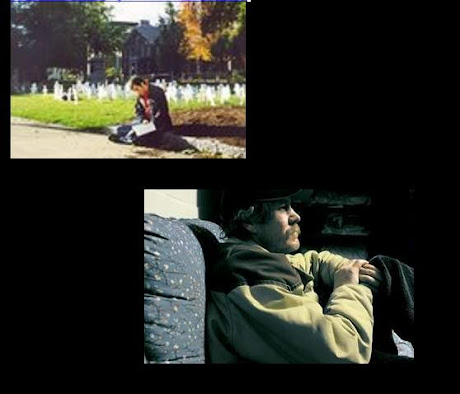
joe and Razor dearly missed


