
Word on the street this week, that the city is closing down homeless camps by throwing away everything and cutting tents. Is it true? I can't get out to the camps any longer. Me and my cane can't make it across the rough terrain so I have to wait and hear. It's been done before and we got some newspaper coverage. what the people may not know is that in the past the lawsuit filed made the city pay each resident who lost belongings for their loss of important papers, IDs, clothing tents bags etc. at $1000 a piece. The city is getting more aggressive in the need to rid the unsightly camps, but where do they expect people to go if they are not allowed at shelter or there is no room?
an advocate never really retires, as news comes in my brain just goes a mile a minute but my body can't follow direction. This all saddens me. for more info and advocacy help contact www.nationalhomeless.org
Manchester NH

Sunday, May 21, 2017

Monday, April 24, 2017
Wednesday, March 16, 2016
Homes Not Jails-Man who sued Hudson in panhandling case found dead in cell at Valley Street jail
For a decade or more we have been trying to address this issue in NH of people who are poor and unable to pay fines on city ordinances, such as sleeping in a park, not be forced to go to jail because they are poor. I personally have sat in the court room with person who appear with city ordinance tickets, they have no money and no way to pay. The Judge tells them to stay in the court until the end of the day. They are allowed to use the phone to try to get the fine paid from friends a relatives, at the end they are taken to Valley St jail for however many days at $50 a day, so a $50 plus court costs ends up keeping the person in jail for 3-4 days wasting precious tax payer monies and creating a barrier to housing by creating a criminal record for being poor.
So as you read this article note near that bottom that FINALLY, " U.S. Justice Department wrote state judges across the country about how the poor are treated in courts. The letter raises issues with court fees, fines and the use of cash bail to incarcerate defendants."
It would like you or someone you love getting a parking ticket and when you are unable to pay because you lost your job or your bills keep your wallet squeaky clean being forced to go to jail for a day plus court costs. Why is it different for those who are experiencing homelessness? -Cindy
March 15. 2016 12:12AM
Man who sued Hudson in panhandling case found dead in cell at Valley Street jail

MANCHESTER — A homeless Nashua man who won monetary claims against both Hudson and Nashua police over arrests dealing with panhandling and vagrancy was found dead in his cell at the Valley Street jail Sunday afternoon, officials said.
Jeffrey Pendleton, 26, had been in the jail since last Wednesday, a day after Nashua police arrested him on a misdemeanor charge of marijuana possession. A Nashua District Court judge had set his bail at $100 cash, an amount he was unable to raise as a homeless person.
Pendleton was found unconscious in his cell at 2:45 p.m. Sunday. Corrections officers, jail medical staff, Manchester firefighters and ambulance workers tried to revive Pendleton, but he was pronounced dead at 3:19 p.m., the jail said in a statement released Monday.
“There appeared no indication that Mr. Pendleton was in any form of distress,” said Superintendent David Dionne. Manchester police and corrections officials are investigating the death. An autopsy was scheduled for Monday, the corrections department said.
Armed with lawyers from the American Civil Liberties Union, Pendleton won settlements from both Hudson and Nashua police departments last year. Hudson paid Pendleton $7,640 after he was ticketed for panhandling on public property. At the time, he held a sign that read, “Homeless and Struggling.”
Nashua paid Pendleton $10,315 after he spent 33 days in jail for walking in a park adjacent to the Nashua library after police forbade him to do so. He died exactly a year after Nashua signed papers agreeing to settle the claims and avoid a lawsuit.
Both initiatives challenged the ability of police to force homeless people from public property.
“We will deeply miss Jeff,” said Gilles Bissonnette, legal director of the ACLU of New Hampshire. He described Pendleton as kind and soft-spoken. He said Pendleton wasn’t looking for monetary rewards when he took legal action against the police departments. He wanted police to stop telling people like him to get out of town, Bissonnette said.
“He knew there were people like him out there having similar interactions with law enforcement,” Bissonnette said. “He wanted change, whether if for a black person or simply a poor person out of work.”
He said the ACLU could not do its work without courageous people such as Pendleton.
“We trust that a thorough investigation will be conducted on the circumstances of his tragic and untimely death,” Bissonnette said.
Nashua police said Pendleton was arrested on March 8 at 10 Kinsley St., a private residence, and charged with misdemeanor possession of marijuana. Police charged him with a Class A misdemeanor, meaning he would face jail time if convicted.
He was arraigned the following day and incarcerated Valley Street jail.
Dionne said Pendleton had been in Valley Street jail before. Two years ago, Pendleton had achieved trusty status, which meant he was given latitude to perform jobs within the prison walls.
“He’s always been nice here, never a disciplinary problem or anything,” Dionne said.
Pendleton was discovered inside his cell during a head count that takes place during change of shift, Dionne said. Jail officials are reviewing video and speaking to inmates to piece together a time line of Pendleton’s last hours. He said the door to his jail cell was closed when he was discovered.
Pendleton’s death came a day before the U.S. Justice Department wrote state judges across the country about how the poor are treated in courts. The letter raises issues with court fees, fines and the use of cash bail to incarcerate defendants.
In the letter, the Justice Department said that bail practices that result in incarceration based on poverty violate the 14th Amendment.
“Systems that rely primarily on secured monetary bonds without adequate consideration of defendants’ financial means tend to result in the incarceration of poor defendants who pose no threat to public safety solely because they cannot afford to pay,” the letter reads- See more at: http://www.unionleader.com/apps/pbcs.dll/article?avis=UL&date=20160314&category=NEWS07&lopenr=160319600&Ref=AR&template=printart#sthash.11yFiKPm.dpuf
Tuesday, February 16, 2016
From The Union Leader : Homeless woman who was evicted from New Horizons struggles for stability
February 12. 2016 9:45PM
Homeless woman who was evicted from New Horizons struggles for stability


IN LATE NOVEMBER, homelessness hit Nancy Duhaime. It came swiftly and painfully, like a brutal cold snap after a disarming January thaw.
It could have been expected, given some aspects of her life. She has family problems. She said she suffers from post-traumatic stress disorder. She hasn’t been able to hold a job long. And alcohol might play a role.
So at 61, Duhaime has been crashing with a friend in a rooming house. When the weather is warm, she sleeps at her West Side campsite. She’s slept at the New Horizons shelter but has also been barred from there at times.
And some nights she just walks, choosing the relative warmth of mobility over the colder option of a restorative shuteye.
When you’re homeless, “you just become a different person,” Duhaime said.
There are consequences for homelessness. Last year in New Hampshire, exposure to cold was the underlying cause of death for at least three people, possibly more because tallies have not been completed, according to the state Division of Vital Records.
Nine died the previous year, but none of the deaths were in Manchester.
I visited Duhaime’s tent site Monday. It’s about a five-minute walk into Black Acres, the expanse of sand pits, woods and power lines on the West Side. She last slept there about a week ago, abandoning it after waking to snow and what the weatherman called a return to normal February temperatures. (See video below or at unionleader.com/homeless).
Last night, that meant wind chills that were expected to drop below zero.
“I want to go to a place that’s safe and warm,” said Duhaime, who tears up when recounting her plight.
Duhaime’s story can be only partially confirmed. She said she had been living for years with a roommate in a Merrimack apartment. On Thanksgiving, the turkey burned, a fight ensued, and the roommate kicked her out.
That Sunday night, Duhaime returned, and Merrimack police arrested her.
“The homeowner asked the subject to leave several times, but the same behavior continued. On the arrival of police they found Nancy Duhaime, now sitting in her motor vehicle drinking a beer,” according to a police summary.
She said she could not go to work the next day, so she lost her job.
“She had some personal issues,” said Mike Mongeau, her manager at Merrimack Tractor Supply Co. Duhaime was a part-time cashier and had worked for the company about three months. She did a good job and was very friendly, he said.
Mongeau did not know she was homeless. New Horizons for New Hampshire, the city’s shelter and soup kitchen, said she first arrived on Dec. 2 and has spent 19 nights at the shelter since then.
Duhaime said she has two sons who live in Manchester, one not far from her encampment. She said they help her out sometimes, but one has taken out a no-contact order. She said he has urged her not to drink when she takes her medication, but she dismisses his concerns.
We spoke several times on the telephone and met twice this week. She never slurred her words, and I smelled no whiff of alcohol.
Duhaime is 5 feet, 1 inch tall and weighs about 110 pounds. She speaks softly; on the telephone her voice is melodic and young. She smiles at times, but she cries easily. And she became irritated, even threatening, when she spoke on the telephone to workers for Mayor Ted Gatsas and Sen. Jeanne Shaheen, threatening at one point to run against Shaheen.
Her biggest issue is New Horizons. For most of the week, she had been evicted from the shelter.
“She’s a very sick woman, and we want her to get the help she needs,” said Kevin Kintner, the program director at New Horizons. He said Duhaime has pushed staff, insulted people and screamed vulgarities.
New Horizons sees about 950 people annually struggle with problems of mental health, drugs and alcohol, he said. They have delusions. They are disruptive. They can’t abide by the rules.
Lots of New Horizons clients get evicted. They are welcome back once they speak with a New Horizons counselor, he said.
Duhaime has her issues with the shelter. Weeks ago, she got thrown out for a mandatory three nights when a beer was discovered in her belongings. She doesn’t like the shelter’s 6:30 p.m. curfew. She said her belongings get stolen.
She said she wasn’t screaming, only crying when her Xanax was stolen.
“I get kicked out for anything,” she said, “I’m scared to death when I go there. I feel like I’m walking up to the gas chamber.”
On cold nights like tonight, New Horizon has a heated hall where anyone can stay, even people like Duhaime who have been evicted from the shelter.
It doesn’t take too long to recognize that Duhaime is caught in a maze of fear and confusion. You lose your home and your bed. Anxiety churns into panic. You don’t sleep. You lash out. Small personality problems are magnified. You deny. You lash out. Who wouldn’t?
Toward the end of the week, Duhaime had visited social workers to restart her food stamps and apply for Social Security disability. (Duhaime will be eligible for Social Security retirement in a few months, she said.) We talked on the telephone, and she seemed positive. She kept an appointment to speak to a mental health counselor.
But when she showed up at New Horizons late Thursday afternoon, she had a black eye, Kintner said.
“The saga is far from over,” Kintner said. “It’s going to take a long time for her to get healthy.”
Mark Hayward’s City Matters appears Saturdays in the New Hampshire Union Leader and UnionLeader.com. He can be reached at mhayward@unionleader.com.
Friday, January 15, 2016
looking fro a speaker to your event?
for people who keep calling asking for speakers to your events, I am unavailable, instead please contact Families In Transition
http://www.fitnh.org/about-us/contact-us/
or
a great writer, passes into the long night
Jamie Kupchun the inspiration for the creation of the NH Under the Bridge Project has passed away on Nov. 18, 2014.
I am saddened. I hadn't seen him in many years, then more recently is was sporadic at best. In the last few months I find he is living in the building next door. Spoken to him on the street. Introduced to his girlfriend.
Yesterday, fire rescue and an ambulance and police car in front of his apartment. His girlfriend screaming from the porch, "he's not breathing" and now he is gone.
In honor of Jamie, I offer another great writer, he would understand.
― William S. Burroughs, Naked Lunch
By The Associated Press
January 13. 2016 4:27PM
Groups sue Manchester, say city violates panhandlers' rights
New Hampshire Public Radio reports the groups argue that the police department has been charging panhandlers with disorderly conduct.
The ACLU chapter's legal director, Gilles Bissonnette, says the behavior isn't a crime in the state. He says the city is twisting the statute's language to criminalize panhandling.
The suit was filed on behalf of a 54-year-old Army and Navy veteran named Theresa Petrello.
The ACLU also sued the town of Hudson two years ago for its attempts to curb panhandling. The town settled.
Officer Ryan Brandreth is also named as a defendant. The city declined to comment.
Monday, August 31, 2015
Heroin and homelessness
In the general population, it is prescription drugs, particularly opioid painkillers, that now are the main cause of overdose death, outnumbering deaths from all other drugs (including heroin) combined. Of the opioids contributing to overdoses in the Boston study, the bulk were indeed painkillers and other non-heroin narcotics.
The toll of substance abuse among homeless people goes beyond fatal overdoses. Other deaths caused by substance use disorders, especially alcoholism, accounted for nearly 8 percent of the mortality in the new study—a two-fold increase over the earlier study. And looking deeper into the statistics, it is clear that addiction plays an even wider role in the high mortality of homeless adults: The high number of heart disease deaths and fact that most cancer deaths were from cancers attributable to smoking (e.g., lung, trachea) reflect the high rate of nicotine addiction among homeless adults, 73 percent of whom smoke (more than three times the rate for the general population).
Homeless people suffer disproportionately from all health problems, and drug abuse and addiction are no exceptions. Despite improvements in healthcare services for homeless people in the Manchester area in the decade and a half ,increasing deaths due to drugs and alcohol countered the other health gains.
since I have been keeping track of homeless deaths in there was a total of 187 in 16 years, in the last 2 years heroin overdoses have surpassed that total.
Thursday, March 12, 2015
pandhandling on street corners Manchester and Concord
Capital city's renewed panhandling ordinance could be a model for Manchester
The Concord ordinance doesn’t prohibit anyone from holding a sign. But it prohibits anyone from distributing, receiving or exchanging any item with the occupant of a motor vehicle located in a public roadway.
Concord City Manager Tom Aspell said the ordinance has cut down on streetside panhandling.
“Once we explain it to people, they get it,” Aspell said. “It seems to be quite effective. Is it perfect? No. But as soon as we send an officer, people disappear.”
Howland said police and social workers estimate that nine out of 10 panhandlers use handouts to satisfy a drug or alcohol habit.
Concord passed the ordinance two years ago with a sunset provision. On Monday, the city council unanimously re-authorized it and removed the sunset provision, Aspell said.
“At least on the ordinance’s face, there’s less of a First Amendment concern,” he said. But his organization monitors Concord to make sure the ordinance is applied even-handedly and is not used to suppress free speech underhandedly, he said.
Aspell said the maximum fine is $500, but it would be up to a judge to decide how much to levy. No citations were issued against drivers, only panhandlers.
Friday, January 16, 2015
Thursday, November 20, 2014
Jamie Kupchun the inspiration for the creation of the NH Under the Bridge Project has passed away on Nov. 18, 2014.

I am saddened. I hadn't seen him in many years, then more recently is was sporadic at best. In the last few months I find he is living in the building next door. Spoken to him on the street. Introduced to his girlfriend.
Yesterday, fire rescue and an ambulance and police car in front of his apartment. His girlfriend screaming from the porch, "he's not breathing" and now he is gone.
In honor of Jamie, I offer another great writer, he would understand.
― William S. Burroughs, Naked Lunch
Wednesday, July 16, 2014
 Published on the Concord Monitor (http://www.concordmonitor.com)
 Train cars sat idle in Concord for two days before homeless man’s death
Source URL:http://www.concordmonitor.com/home/12682514-95/train-cars-sat-idle-in-concord-for-two-days-before-homeless-mans-death
Tuesday, July 15, 2014
Friday, December 20, 2013
The National Homeless Memorial Day Services will be held this year at these locations:
Nashua
Wednesday, December 18 at 5 pm at Main Street Methodist Church, Nashua
Contact: Eileen Brady, Nashua Soup Kitchen and Shelter, eileen@nsks.org
Portsmouth
Thursday, December 19 at 5:30 pm at Market Square, downtown Portsmouth
Contact: Jessica Brazeau, Crossroads House, j.brazeau@crossroadshouse.org
See event on Facebook: https://facebook.com/events/
ConcordFriday, December 20 at 4 pm at the City Plaza (on N. Main Street, in front of the State House), Concord
Contact: David Keller, Concord Coalition to End Homelessness, davidandlindy@myfairpoint.net
ManchesterSaturday, December 21 at 7 am at Salvation Army, 121 Cedar Street, Manchester
Vigil organized by Do You Know Him Ministries
Contact: Bill Sullivan, bjckm76@gmail.com
NewportSaturday, December 21 at 5 pm at Newport Commons
Contact: Alice Roberts, aliceandruss@comcast.net
LaconiaSaturday, December 21 at 5 pm, Veterans Square, Laconia
Contact: Len Campbell, NH Catholic Charities, lcampbell@nh-cc.org
KeeneSaturday, December 21, 5:30 pm at Central Square, Keene
Contact: Deb Chambers, Hundred Nights Shelter, hundrednightsshelter@gmail.com
PeterboroughSaturday, December 21 at 5:30 pm, outside of the Peterborough Town House, 1 Grove Street, Peterborough
Candlelight vigil sponsored by the Monadnock Area Transitional Shelter
Contact: Joan Foucher: (603)547-7600
Monday, September 16, 2013
They Called Him "Crazy Scotty on the Bike"
Scotty passed away 9/14/13 he was 68
what does it take to end homelessness? I don't believe it is creating more institutional programs but it takes a connection one person to another, one day at a time.
Someone called me tonight and said, Hey I heard that "Crazy Scotty on the bike died" I have not heard of him referred to as that for years and it prompted me to tell you this story.
I met Scotty in 2001 when I was on an outreach run under the bridges in Manchester. I had a box load of peanut butter and jelly sandwiches in the truck and he went riding by on his bike. It was summer and he had on shorts and he was shirtless. He is a man of small build, but strong shoulders. His hair was graying, shoulder length and wild from the wind.
I yelled, " Hey you, want a sandwich." He got off his bike huffing from a long ride and came over. He asked, " Why would you be giving me a sandwich?"
I explained that I give out sandwiches on Sundays to folks who are un-housed because I know the drop-in centers are closed, as is the recycling centers and it was a good way for me to check conditions of folks. I have plenty, have one. He accepted the sandwich and went on his way.
Months later I would hear from others that he was asking the guys, "who is the crazy lady wearing moccasins and passing out sandwiches under the bridges?" I bumped into him a few more times fall, still riding around on his bike. Polite conversations but he wasn't really giving up information about himself. Obvious trust issues for obvious reasons.
Where I lived was no secret to most people, smack in the middle of the city, it was. I had brought people up to shower at times, cut their hair, use the phone, (before cell phones). I could help them to get needs met that they couldn't otherwise do because they were evicted from programs that were meant to serve them. Most were drunks that couldn't follow the rules well enough, some were otherwise diagnosed, but I am able to look beyond labels and just love them like the lessons of Mother Teresa and her lepers. I always had other company at my house for safety, but each person was treated with respect and dignity as a child of the Creator who made them and I. And I am also a drunk, though I have been in recovery a long time. I understand the disease and the incomprehensible demoralization that goes with it. I understand the wreckage that causes us to lose our families, our housing and left on the outside of society. When I turned my life around after my own homelessness, I was determined not to forget where I came from. Perhaps too, this helped me to stay clean and sober. I never had to stay out there. I could visit folks but come back home and be grateful.
That winter in the bitter cold I heard a knock at my door. When I opened the door there stood Scotty and he immediately said, " No hospitals" and he collapsed. My daughter and I got him to the couch. He was burning with fever. He stayed for three days until his fever broke. I nursed him like you would a sick child. When he was better his was able to share a little more of his life with me. I can't tell you what his story is because it is private. But I can say that he was homeless for the last 30 years. He lived in a bus at a flea market for a while, in the back of a store where he was working, at one time, and mostly he would just ride his bike until he collapsed and slept in the bushes. He said I was the first person who gave anything to him with out any expectations of a return.
In the spring he was sick again he collapsed in the street and was taken to hospital by ambulance. He was diagnosed with COPD and given inhalers to use. I could not get him to sign up for State Medicade, though the social workers at the hospital and I gave it our best shot. He was full of fear. He stayed a few days and went to his place, which was now a tent in someone's backyard. He was helping the owner repair a roof.
I'd see him now and again as he road his bike to some of the same AA meetings that I attended. He always stood outside of the group, by the exit as though he needed to make a quick escape. People did not approach him as he seemed unapproachable. But I knew better and kept trying to engage him as often as possible.
Years went by and he finally decided he would accept help and took an opportunity to become housed at the Robinson House, a sober house for men. To do so he had to attend a 28 day program of recover and then he would get a room. Sounded easy enough but there was much paperwork involved with the State Welfare and Social Security Office and he just couldn't handle agencies, their questions and all that paperwork. So I became his authorized representative as he could talk to me and I could work with agencies as appropriate. He went to rehab. I filed for a birth certificate for him, a requirement of housing.
In 2005 he got into the Robinson House. He changed from skittish Scotty to the go-to man for answers on herbalism and natural healing and all about sobriety. He had never used a computer and it was fun showing him how to create his first email account. Once he figured out that all the answers to his questions were right there at his fingertips, he spent many hours researching subjects of alcoholism and the founders of AA, as well as anything related to health, his and others. He was a naturalist and didn't like pills. The doctors had told him he had about six months to live and he was determined to prove them wrong.
His room became cluttered with books and videos on everything from Joseph Campbell's, Hero of a Thousand Faces to the Natural History of Medicinal Plants. He scoured the internet and shared info with others of what he found about excitotoxins and food additives that kill. He was intelligent in that he always asked, "why?"
He had never gone very far in school. He was what he called, " a misfit" it was of course before the special education programs and so he just went to work on a farm. He had six toes on one foot and thought it was from his fathers service in the military -WWII. He did research on chemical weapons used during that era.
These things set his apart from his peers so he learned to count only on himself. He continued to be a man who worked all his life when he could use his hands in the trades. He learned to read, and what he couldn't pronounced he just memorized what the word looked like. He was nearly blind and would sit at the computer wearing layers of reading glasses.
To those of us who took the time to know him, he was not Crazy Scotty, he will be remembered as a brilliant man. He was counselor to many men in the program where he lived, He had wisdom of his life experiences and he was loved by many. His presence in our lives will be missed.
I'm told he had the nurses at the hospital laughing on Friday night and then he peacefully died in his sleep. Sober, like he wanted.
So today in the year 2013, 8 years after he was told he had 6 months to live, I did the last piece of advocacy for him. I went to City Welfare and filed the papers of his indigent status so that they could sign off on a cremation over at the Phaneuf Funeral home. When I collect his ashes and we will come together again to remember him as we plant a tree in Manchester.
Friday, July 12, 2013
Letter: Homeless trouble in
Concord: We are all responsible
For the Monitor
The Board of Aldermen is scheduled to vote on a proposal to install 'homeless meters' in six locations around the city.
By PAUL FEELY
New Hampshire Union Leader
The proposal to install the meters was submitted earlier this month by Manchester Aldermen Pat Long, Ward 3, to the city’s Committee on Traffic. In the plan the devices are termed “Spare Change Meters.” They are repurposed coin-operated parking meters set up to collect donations for designated nonprofit organizations.
Long said he would like to see five or six of the city’s old parking meters installed in some of the most heavily panhandled areas of Manchester, including Elm Street. Money deposited in the meters would go directly to organizations that help the homeless. The goal, Long said, is to reduce panhandling and educate business owners and residents about the problem of giving money directly to people on the streets.
• The locations for the meters be determined by the Parking Division and Highway Department
• All donations received after the $260 threshold is achieved would benefit the organization New Horizons.
“We would paint (the meters ) a new color, maybe red or blue, so they stand out from the ‘Pay and Display’ parking meters,” said Long. “They would be clearly labeled to say what group would benefit from any donations made.”
“We’re already hearing from some business owners, especially in the downtown area, about aggressive behavior shown by panhandlers,” said Manchester Police Chief David Mara. “A lot of the people we recognize as people who are not homeless. People give them cash, and they are feeding their addictions to alcohol or drugs.”
The Manchester Police Department Community Policing Unit will soon begin increased visibility patrols downtown during the work week lunch time frame. Community police will also meet one-on-one with downtown business and property owners to discuss panhandling and other downtown quality-of-life issues. Mara said during these visits his department will conduct a survey to determine the effect of panhandling on Manchester businesses.
Thursday, January 26, 2012
occupy movement
Protesters set up camp in
I've held signs in the park and marched yelling, "we are the 99%" down the main street of our little town, even spent a night or two in the parks against city ordinances, had my face on the news in a crowd scan with my veterans cap on, but I leave feeling simply tired.
Here in Manchester they have welcomed participation of people experiencing homelessness, but there have been some problems related to that as well.
I think my issues of understanding exactly what is happening is likey similar to many others. I simply do not understand politics, I do not have the brain capacity to sort out and follow all the details of who is doing what and why. I can't follow money markets and stocks, and my brain just doesnt retain these things, even as Martha Stewart went to jail for "insider trading" I don't understand what that is, aren't you sipposed to sell your stock before it falls?
I'm not dumb, I have a college degree and I work in my community, I have worked to pass legislation as it pertains to my interests, but I basically can not understand how the government works. we pay taxes and they spend it however they want.
I don't support war
I do understand social movements of people, nothing changes without struggle. The occupy movement folks that I have had contact with also seem to understand that and I hope the movement can somehow define itself and include a diverse population including Class socioeconic divisions
I'm an old hippy with high hopes, I remember history of the movement, also the violence perpertrated on protesters, Im not looking to be pepper sprayed, or be shot with rubber bullets or other projectiles, I guess I would have to know what I am standing up for, how we are going to accomplish those goals and be in agreement with whatever stand
Right now I am just confused.
Sunday, May 1, 2011
poem-My Homelessness
My Homelessness
Don't concern yourself with
When, why or how I got here
The road taken was not my choice
Just know I battled demons
On this lonely desolate Road
I boldly confront you daily
Endlessly, seeking your money
But what I desperately need
Is a moment of your time
A glance, a smile, a hello
A resemblance of pure love
So don't pretend I'm invisible
Treading over me continuously
Ignoring my worldly existence
This tired, weary and broken body
Of shivering bones, parched lips
Lives in a hole in the ground
Or a thin cardboard Shelter
Mostly alone, cold and hungry
I don't want your artificial pity
Or bold unsolicited comments
I fiercely want what we all want
To desperately not be invisible
I AM HUMAN AFTER ALL.
submitted via email
Thursday, April 7, 2011
Dennis (aka Binky) Hudson

August 6, 1961-April 3 2011
I met Dennis in the spring of 2000. He had just arrive from Portsmouth and was rough sleeping in the park. He quickly became involved with our project. The first year he simply got acclimated to the city. On Decemeber 21st he led us in reading the names for National Homeless Memorial Day. ( picture above)
He served on our speakers bureau,and has spoken at every college in NH and on to Harvard. He was a reporter for the Under The Bridge Street News. He went to Covington Kentucky with us and the National Coalition for the Homeless Rapid Response team. Later he also went to Washington DC for the National Bringing America Home Conference.
He loved talking with students about social and economic justice and in 2003 he starred in a UNH student film called "Lost and Found" he played the leading role of Dexter. The film won awards at the NH film festival.
If you want to copy and paste this link you can read about it in the student newsletter and see a good picture of him.( think its the 3rd page)
http://www.unhm.unh.edu/pdf/millworks/2004-millworks-winter.pdf
2007 brought a dibilitaing illness and a coma and when he was released from the hospital his was severly compromised. He was housed and doing the best he could do when he succumbed to his illness.
He will be surely missed by many. We held memorial in the park at his favorite bench.
May you walk in Beauty Forever Binky
Aho!
Tuesday, October 19, 2010
Jimmy

Photo By Preston Heller
lost and found
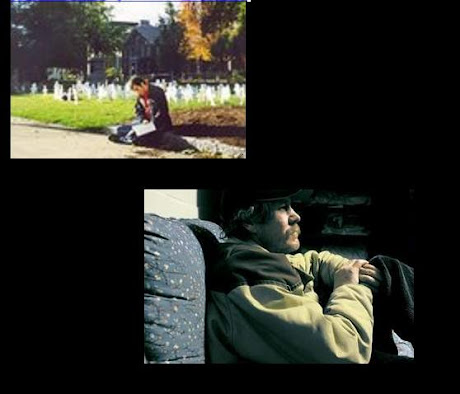
joe and Razor dearly missed


